FCDO travel advice & your travel insurance – what does it mean?
Finding the right travel insurance
Travel insurance is unusual: you buy it hoping that you’ll never need it. It’s a worst case scenario safety net, which can prevent a difficult situation from becoming an awful one. When it comes to holiday incidents, happily, the more serious the incident is, the less likely it is to happen. However the associated costs tend to rise in direct proportion with the seriousness of an issue, which magnifies the problem. You might need to claim a refund for a lost or stolen camera (low cost), get hospital treatment for a persistent stomach bug or broken finger (mid cost), or the cost of an air ambulance during a medical emergency (very expensive – but also incredibly unlikely).
Small print is both dull and daunting – but when it comes to travel insurance, understanding exactly what you have signed up for is crucial. You may need to upgrade your cover to include expensive items such as laptops or cameras, or adventurous sports such as rafting, diving or quad biking.
For British holidaymakers, it’s also important to understand exactly how your cover is affected by the travel advice issued by the Foreign, Commonwealth and Development Office (FCDO). If you travel to a region which the FCDO advises against visiting, in most cases your insurance will be invalidated.
However, we can sell travel insurance that will cover you via Campbell Irvine – which will cover travellers in these regions under certain circumstances. For example, Chad is on the FCDO’s red list (see below) due to security issues and a high risk of terrorism. If you visit Chad and fracture your ankle walking down a sand dune, the insurer may cover this and refund medical care or offer emergency evacuation to the nearest suitable hospital. If a flash flood washes your luggage away, it might be possible to claim back costs. But if your hotel is evacuated due to a terrorist attack – the insurer reserves the right to decline a claim, as this is a direct consequence of travelling against the FCDO advice.
Talk to Campbell Irvine
It can take a while to ensure you have the best possible cover, but if travelling to high risk area, it is absolutely worthwhile to invest the extra time. The chances are that if something does happen – even something as simple as a twisted ankle or a lost passport – you will be further from a clinic or consular support, and this is when you will need back up.
Campbell Irvine offer bespoke travel insurance, and their application forms allow you to send them the details of your trip – rather than just purchasing an off-the-peg policy. Unusually, they cover areas with FCDO travel warnings. At Responsible Travel we offer trips to over 190 countries – and several of these have regions which the FCDO advises against travelling to, so we have partnered with Campbell Irvine to provide the most comprehensive cover, wherever you are in the world.
What is the FCDO travel advice?
The British Foreign, Commonwealth and Development Office (FCDO) is a government department which represents Britain overseas, and is responsible for foreign policy. If British citizens get into difficulties while abroad, the FCDO may be able to offer help and advice.
Travel advice for each country is published on the FCDO website. This includes general safety advice regarding crime and terrorism, as well as natural disasters such as hurricanes and earthquakes. We always recommend reading this advice before travelling to any destination, no matter how close to home – this is an extremely useful resource for travellers, with advice on every country all in one place.
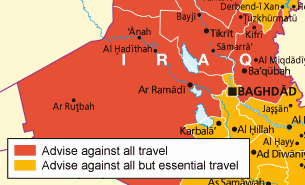
FCO Iraq map example from Feb 2016
Ultimately, as a British citizen, travelling into an area which the FCDO advises against is likely to invalidate your travel insurance, unless you have taken out a specialist policy such as those offered by Campbell Irvine.
How up to date is the advice?
While travel warnings seem to be put into place very rapidly following a natural disaster or other incident, they may take time to be removed. For example, a yellow travel warning was issued for the regions of Nepal affected by the April 2015 earthquake. Despite many routes opening again in November of that year (albeit with some disruption on parts of the trails), the warnings remained in place. for many months
It is also likely that the advice tends to be more cautious in countries where the British government has no consular presence – partly because of the difficulty in obtaining accurate, up to date information, as well as the lack of support for travellers who do experience any problems.
Do all countries issue the same travel advice?
Not always. Even some countries that you would assume would have similar views can differ wildly. Australia’s Department of Foreign Affairs and Trade performs a similar function to Britain’s FCDO – but the advice is often very different. At Responsible Travel, many of our travellers are from the UK, hence this article about FCDO advice – anyone residing in other countries will need to check their own government’s travel advice and terms and conditions of their insurance in the case of travel warnings. And make sure you purchase the correct insurance which covers you for the region you are travelling in.