What makes Cyprus so unique, and such a boundlessly interesting place for an archaeology tour, is the sheer number of civilisations that have left their traces on this tiny Mediterranean island, just a two-hour drive from east coast to west along the coastal highway.
The Venetians were here in the 15th century, and before them the Byzantines, the Romans, the Persians and the Phoenicians, even the Egyptians very briefly. After nearly a century the Ottomans sent the Venetians packing, and then the Turks were themselves usurped in 1878 by the British Empire, as it looked to protect its shipping routes. The island today is partitioned, following another Turkish invasion, which displaced thousands of Cypriots. Prior to all of this there is evidence of early Greek settlement on Cyprus, and some of the world’s oldest Neolithic sites have also been found here, with the village of Khirokitia now a UNESCO World Heritage Site. For those with an interest in archaeology and history, this is a gold mine.
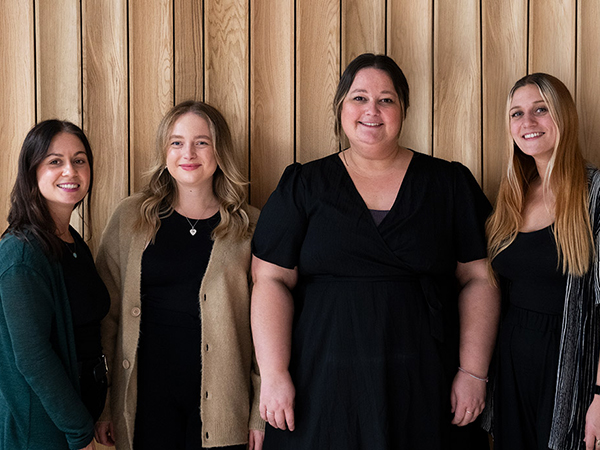
“I can't think of anywhere else that's got so many civilisations in one place,” says Monique Skidmore, founder of our partner Take Me To Europe Tours. “It’s small, and yet so rich archaeologically.” Situated between Asia and Europe, Cyprus has been tussled over by empires for centuries, and our
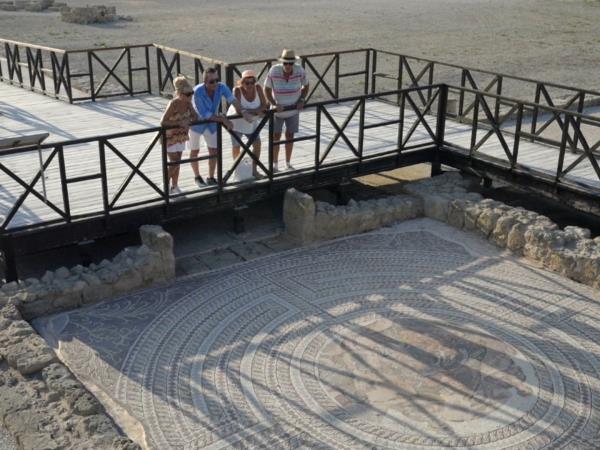
Cyprus archaeology tours help bring this fascinating history vividly to life.
Because on our trips you’re not just following a guide from place to place, struggling to marry a stream of facts and dates with the ruins you’re picking your way around. Instead, through carefully planned cultural encounters led by warm and well-qualified local tour leaders, these holidays add depth and colour to your knowledge, helping you to see Cypriot history not as a dusty pile of rocks, but as a living thing.
“I think there's a really interesting continuum between the present and the past that you can show people in a fun, lived way,” continues Monique. “Seeing the sunset where Aphrodite came naked ashore, eating food from Ottoman and Christian times, speaking to winemakers using techniques that would have been employed centuries ago, in addition to trying to understand the history of settlement, can give people ‘wow’ moments that are a bit transformative. That's what I'm trying to do. Then it’s not just a bunch of stones that were knocked over by the Romans, it’s more experiential. And that in turn offers economic benefits to many local producers, restaurants, and small communities.”










_(33).JPG)

