Climbing Mount Kenya

Higher than Mont Blanc, neighbouring the equator and skewering the clouds, Mount Kenya has celebrity charisma without hogging the limelight![]()

It might seem impossible to ignore a mountain – especially when it’s over 5,000m high. But that’s what’s happened to some extent to Mount Kenya. A dormant volcano with flanks moulded by glaciation, Africa’s second-highest peak has been metaphorically overshadowed by Mount Kilimanjaro, 400km south and over the border in Tanzania. Kili gets 20 times more visitors, with trekkers looking to summit Africa’s highest mountain irrespective of its merits, yet Mount Kenya can trump its neighbour in all but height.
It’s scenically spectacular, with jagged peaks, glaciers, waterfalls and U-shaped valleys crafted over three million years of erosion. The mountain’s lower reaches boast a diverse mix of flora. From forests thick with towering stands of bamboo and huge podocarpus and pencil cedar trees up to heather moorland at around 3,000m, which could pass for a Scottish glen. Lower down, elephants bash paths through dense forest shared with buffalo and hyena; higher up, you’ll spot rock hyrax, sunbirds and the odd high-altitude zebra.
Climbing Mount Kenya also tends to be quicker to climb than Kili – a week rather than 10 days – making an organised ascent less expensive, but no less arduous. This is a tough, challenging trek at altitude. Expect a huge sense of achievement on completion
Read on for our best Mount Kenya trekking tips…
It’s scenically spectacular, with jagged peaks, glaciers, waterfalls and U-shaped valleys crafted over three million years of erosion. The mountain’s lower reaches boast a diverse mix of flora. From forests thick with towering stands of bamboo and huge podocarpus and pencil cedar trees up to heather moorland at around 3,000m, which could pass for a Scottish glen. Lower down, elephants bash paths through dense forest shared with buffalo and hyena; higher up, you’ll spot rock hyrax, sunbirds and the odd high-altitude zebra.
Climbing Mount Kenya also tends to be quicker to climb than Kili – a week rather than 10 days – making an organised ascent less expensive, but no less arduous. This is a tough, challenging trek at altitude. Expect a huge sense of achievement on completion
Read on for our best Mount Kenya trekking tips…

Our top trip
Mount Kenya trekking holiday
Mount Kenya high altitude trekking trip to Point Lenana
From
US $2500
8 days
ex flights
Tailor made:
This trip can be tailor made December - March & July - mid October
This trip can be tailor made December - March & July - mid October
Mount Kenya climbing routes
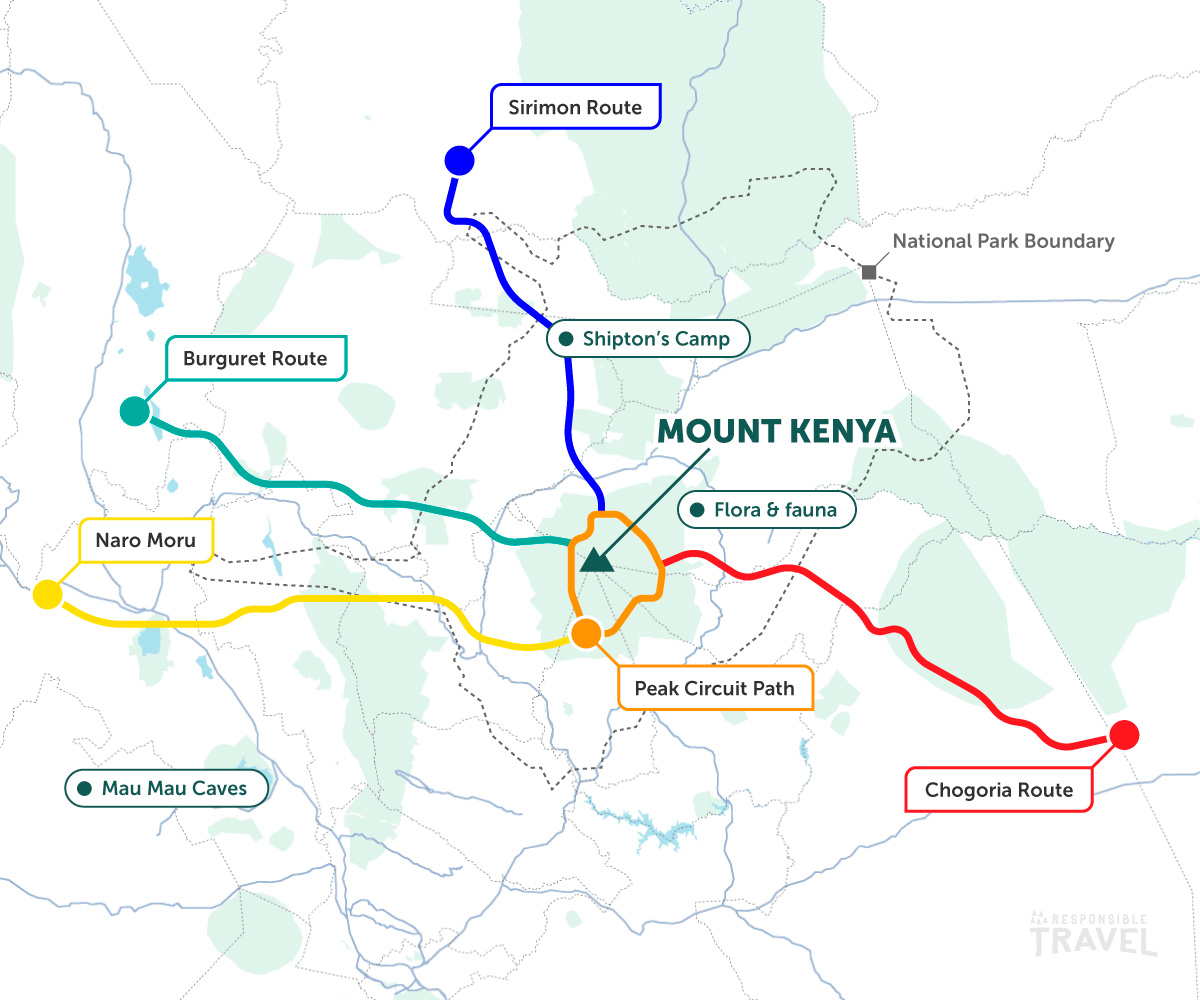
You’ve got options when it comes to trekking Mount Kenya, as there are several possible paths up to the summit. We compare the merits of the four most used Mount Kenya trekking routes to help you plan your trip. Most pre-arranged treks up Mount Kenya include transport to and from Nairobi, and begin in the small towns of Nanyuki or Naro Moru.
“I recommend the Chogoria route and an early morning ascent of Point Lenana from Lake Michaelson,” says Lucy Booth of our partner Kenya Treks. “There is not much scree on this approach so it is fairly straightforward to approach the summit.”
This is one of the most accessible routes up, well suited to any keen hill walker, with basic bunkhouses lining the way. However these huts are not well maintained, and our Mount Kenya walking tours will now often feature four nights’ full service camping and one night in a basic lodge. Camping is a far more enjoyable and pleasant experience, and means less contact with other trekking groups.
Burguret Route
You sometimes don’t meet a soul on this little used wilderness path, and guides may need a machete to clear vegetation obscuring it at lower levels. Trek up to high altitude moorland, dotted with weird, giant lobelia and senecio plants and camp by sheer lava cliffs, enjoying views of Batian and Nelion from the Burguret Valley. Descend via the Sirimon route for a full experience of the mountain.Chogoria Route
Chogoria is a longer trail and it takes a jeep journey from Chogoria town to reach the park gate, but for many this is the loveliest route. Long days trekking on good paths with wide vistas, great camp sites and fascinating flora and fauna are on offer. You’ll pass waterfalls, Lake Michaelson and Lake Ellis, and the spectacular Gorges Valley, but the trail is never crowded.“I recommend the Chogoria route and an early morning ascent of Point Lenana from Lake Michaelson,” says Lucy Booth of our partner Kenya Treks. “There is not much scree on this approach so it is fairly straightforward to approach the summit.”
Naro Moru Route
Naro Moru may be the fastest of the various Mount Kenya summit expeditions, usually taking around four days, but it’s not the most interesting or dramatic. There are some highlights, though, such as the Mau Mau caves. Approached through the forest at the base of the mountain, the caves boast rapids and a waterfall, as well as great historical significance. During the Mau Mau Uprising of 1952 to 1960, freedom fighters used these caves as a hideout from colonial British forces, who tried to bomb them but, fortunately, missed.Sirimon Route
The Sirimon route on the northwestern side of Mount Kenya is very scenic, plus the altitude gain is nice and steady and it tends to be drier. Some treks use this route for the descent only after tackling the summit of Lenana Point, ascending instead by the Burguret or Chogoria routes. Trek up from the dusty lowlands, through ancient forests, into unusual glacier-sculpted heathland before approaching the jagged volcanic peaks and glaciers of Mount Kenya’s summit.This is one of the most accessible routes up, well suited to any keen hill walker, with basic bunkhouses lining the way. However these huts are not well maintained, and our Mount Kenya walking tours will now often feature four nights’ full service camping and one night in a basic lodge. Camping is a far more enjoyable and pleasant experience, and means less contact with other trekking groups.
Contact Us
Call us for a chat about our holidays. We are happy to discuss your holiday and help in any way we can. No bots, queues or awful hold music.

01273 823 700
Call us after 9am
Calling from outside the UK

What does climbing Mount Kenya involve?
How long does it take?
Most Mount Kenya walking routes require around five days of trekking. Pick a holiday that includes acclimatisation measures, too, either climbing high and sleeping low, or an extra night spent half way up the trail or just below Lenana Point, before the summit attempt.Expect a mix of half days of hiking (four-five hours) and some more demanding full day hikes. Some itineraries include the pre-dawn trek to the summit, plus a long descent to Old Moses Camp from Shipton’s Camp, a distance of 14km and the recipe for a very long day of walking. Choose your trip carefully and be realistic about your fitness levels.
The summit push up to Lenana usually kicks off around 2am, with head torches and perhaps the moon lighting the way.![]()
Climbing or trekking?
There are two peaks over 5,000m on Mount Kenya (Batian and Nelion), but mere mortals leave these big’uns to experienced mountaineers. For those of us armed only with stout calves and a sense of adventure, “climbing” Mount Kenya is in fact trekking, and the trekkers’ goal is Point Lenana, at 4,985m. You won’t need technical experience to reach it, but that doesn’t mean it’s a walk in the park. The terrain is varied and often challenging. Dense bamboo forest, boggy moorland and boulder fields test your fitness and agility.
At lower levels, paths can be wet and slippery or disappear into thick vegetation, while at upper altitude expect ice and freezing conditions, with areas of scree and loose rock and no permanent footpaths around the summit. In order to see the sun rising over the vast Kenyan plains, the summit push up to Lenana usually kicks off at around 2am, with just head torches and perhaps the moon lighting the way. So, not easy, but never boring either.
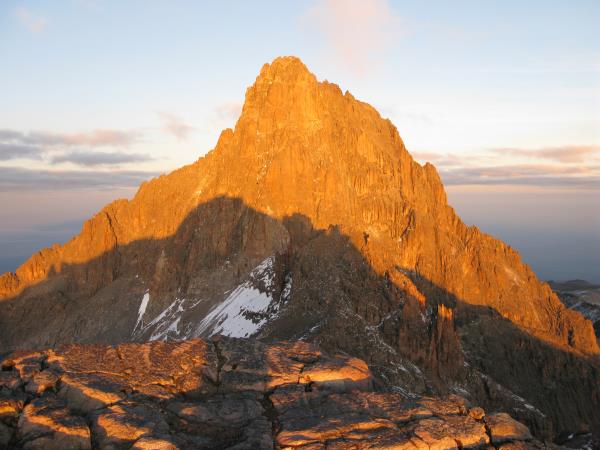
Bear in mind, though, that the only way isn’t necessarily up on Mount Kenya. You can enjoy high altitude trekking without the pressure of a summit challenge. We can help you with organised walking holidays that explore the eastern foothills of Mount Kenya, taking in spectacular waterfalls, lakes and the mini peak Mugi Hill. From here, you can watch the sunrise turn the main peaks bright orange – a view no one on the summit of Lenana ever gets.
At lower levels, paths can be wet and slippery or disappear into thick vegetation, while at upper altitude expect ice and freezing conditions, with areas of scree and loose rock and no permanent footpaths around the summit. In order to see the sun rising over the vast Kenyan plains, the summit push up to Lenana usually kicks off at around 2am, with just head torches and perhaps the moon lighting the way. So, not easy, but never boring either.
Bear in mind, though, that the only way isn’t necessarily up on Mount Kenya. You can enjoy high altitude trekking without the pressure of a summit challenge. We can help you with organised walking holidays that explore the eastern foothills of Mount Kenya, taking in spectacular waterfalls, lakes and the mini peak Mugi Hill. From here, you can watch the sunrise turn the main peaks bright orange – a view no one on the summit of Lenana ever gets.
Eating & sleeping
The accommodation on a Mount Kenya trek is usually tents. This gives flexibility, as you can stay in more scenic locations off the trail, such as on the shores of the mountain’s lakes. Our camping trips are fully serviced and therefore tend to be more expensive than staying in Mount Kenya’s bunkhouses, as they demand more organisation, with more porters needed to carry equipment. All food and water is carried by porters too, and prepared along the trail by the cook. Expect simple, hearty meals, perhaps with fruit to snack on in between.
The Sirimon route is the only trail with huts all along it, while other routes have a handful of simple bunkhouses. These are basic and shared by men and women, with multiple beds in each room. You’ll need to bring your own sleeping bag – at least a three seasons thickness – and a bed roll. Some treks make use of Shipton’s Camp, one of the larger bases on the mountain, with a big bunkhouse. It’s a dreamlike setting, towered over by the three highest peaks, but also Sendeyo and Terere, two ancient volcanic vents of the main peaks. Pause for breakfast here after summiting Lenana, while mountain buzzards soar above and sunbirds flit around the rocks and giant groundsel.
“To be honest Mount Kenya’s huts are pretty basic, and some would say they are pretty grim,” says Lucy. “This is why we tend to camp and avoid them. Some visitors like the idea of meeting up with other trekkers although, to be honest, groups tend to keep to themselves. The real benefit of the huts is in bad weather. If it is pouring with rain, it can be more appealing to go ‘inside’ than go into your small tent wearing wet clothes. I think on balance camping is more of an adventure and means you can go to places which you wouldn’t otherwise see, for example, the lakes.”
The Sirimon route is the only trail with huts all along it, while other routes have a handful of simple bunkhouses. These are basic and shared by men and women, with multiple beds in each room. You’ll need to bring your own sleeping bag – at least a three seasons thickness – and a bed roll. Some treks make use of Shipton’s Camp, one of the larger bases on the mountain, with a big bunkhouse. It’s a dreamlike setting, towered over by the three highest peaks, but also Sendeyo and Terere, two ancient volcanic vents of the main peaks. Pause for breakfast here after summiting Lenana, while mountain buzzards soar above and sunbirds flit around the rocks and giant groundsel.
“To be honest Mount Kenya’s huts are pretty basic, and some would say they are pretty grim,” says Lucy. “This is why we tend to camp and avoid them. Some visitors like the idea of meeting up with other trekkers although, to be honest, groups tend to keep to themselves. The real benefit of the huts is in bad weather. If it is pouring with rain, it can be more appealing to go ‘inside’ than go into your small tent wearing wet clothes. I think on balance camping is more of an adventure and means you can go to places which you wouldn’t otherwise see, for example, the lakes.”
Fitness & safety
Your Mount Kenya trek fitness requirements need to take into account five days of point-to-point walking, rough terrain and high altitude. You’ll require some training, but not necessarily any high-altitude experience. While altitude sickness on Mount Kenya is a risk there’s no way of knowing how well you’ll acclimatise to being above 3,500m, and even experienced climbers can’t be certain they will, as it were, ‘walk it’! The acclimatisation process can differ from climb to climb and doesn’t respect fitness.
You’ll need good walking boots that you’ve already broken in, perhaps walking poles, and lighter trainers or walking shoes are good for the lower levels. Stay hydrated, take it slow and listen to your guide’s advice on pacing. This is not a trek to rush, but to enjoy.
You’ll need good walking boots that you’ve already broken in, perhaps walking poles, and lighter trainers or walking shoes are good for the lower levels. Stay hydrated, take it slow and listen to your guide’s advice on pacing. This is not a trek to rush, but to enjoy.
Guides & porters
While you can trek independently, it’s challenging, and few people risk it. Our fully organised, guided treks on Mount Kenya are the safest option, with a support crew usually consisting of a cook, porter for the cooking gear, plus one porter per trekker. Crucially, there will also be an experienced local guide who can regulate your pace, diagnose altitude sickness if necessary and make critical decisions, while also sharing a deep knowledge of the wildlife and flora on the mountain. All guides and porters must be registered with Kenya Wildlife Services and should also be a member of one of the local guide and porter associations. Our trips thus help to create significant employment in communities around Mount Kenya, and opportunities for guides to earn useful qualifications.
Our partners ensure that guides and porters are treated fairly at all times. Sadly, not every travel company does. Reports of porters trekking in welly boots are not unheard of. Questions you might ask if planning a trip independently include whether your porters have wet weather and cold weather gear (it can drop to -15°C at night at higher altitude), where will they sleep, and whether they are kitted out with suitable footwear?
Our partners ensure that guides and porters are treated fairly at all times. Sadly, not every travel company does. Reports of porters trekking in welly boots are not unheard of. Questions you might ask if planning a trip independently include whether your porters have wet weather and cold weather gear (it can drop to -15°C at night at higher altitude), where will they sleep, and whether they are kitted out with suitable footwear?
Combining Mount Kenya with a safari
Unless you’re really time pressed, don’t just bag the summit and fly home – stick around and combine Mount Kenya with a safari. Samburu National Reserve is a couple of hours away, where lion, leopard and cheetah roam, and the mountain itself sits within the Laikipia Plateau, a patchwork of communal conservancies where local communities manage the land. As well as protecting wildlife – most notably both black and white rhino plus rare wild dogs – the lodges all employ and train local people. If you have more time then you can journey by road from Mount Kenya to the Masai Mara via the Rift Valley Lakes. Allow around six days for this extension.
Although Kenya lies in the tropics, the temperature on the mountain depends more on altitude than season – it’s always cold at the top!![]()
When to go
Trekking tours here run year-round, but the safest and best time to trek is during the dry seasons: January to February and July to early October, when Mount Kenya weather conditions are most reliably fine. Avoid the two rainy seasons, mid-March to June and late October to end of December. At any time of year, the temperatures can vary wildly during a single day. Above the cloud line and in the sunlight, it can get above 20°C, but nights can be freezing at the highest camps, with ice and snow on the trails. It’s also possible to meet wet and snowy conditions at any time of year.
More Climbing articles
Is the time right to take a step up from indoor walls? Our guide will take you to new heights.
Adventurous travellers can shoot for the summit and experience a unique part of the world in a single trip.
Get to grips with the basics, discover what rock climbing entails and find out how to respect the rock.