Elephant watching in Thailand

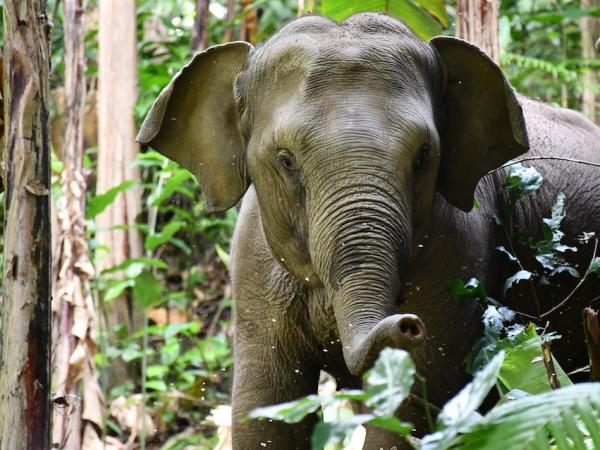
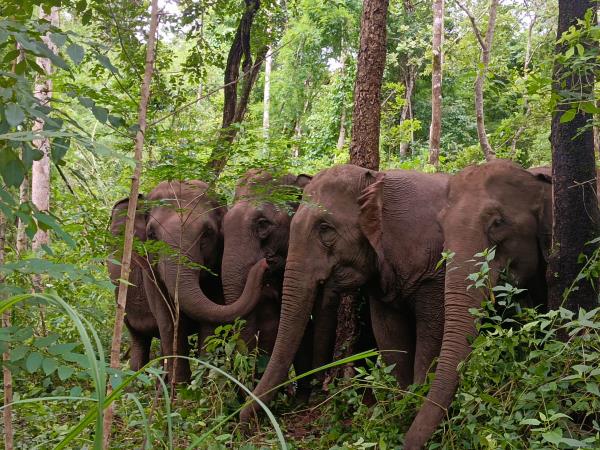
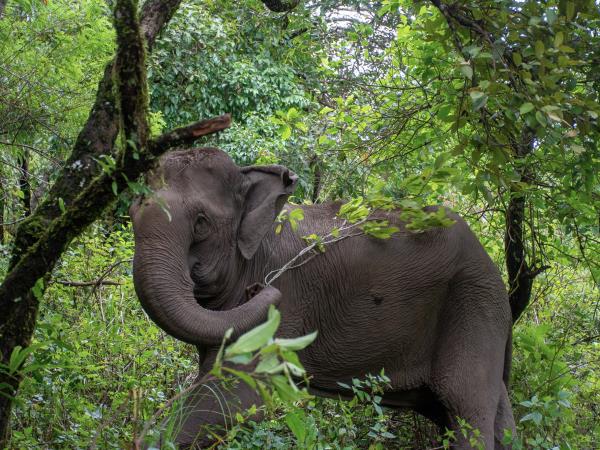
Sitting in silence, perched a little way up a bank, you watch in awe as a huge elephant, encrusted with mud, brushes through the trees, pulling down branches with her powerful trunk. She chews ponderously for a while, then stops to bellow noisily. Answering her call, a pair of young elephants comes charging out of the undergrowth, bumping up against each other playfully, and breaking off low-hanging branches in imitation of their mother. By now they’re used to being observed from a distance by small groups of humans, and they pay them about as much attention as they would a bird in the sky.

“Even after all these years I could still spend all day with them,” says Sarah Blaine, the co-founder of our partner Mahouts Elephant Foundation, about the experience of elephant watching in Thailand. “People feel overwhelming emotion seeing them in the forest. They are magnificent, covered in mud, displaying natural behaviours. We’ve had grown men burst into tears.”
Captive elephants coexist with people, so our ethos is if you don’t help the people you can’t help the elephants.

Elephant tourism in Thailand: the poverty trap

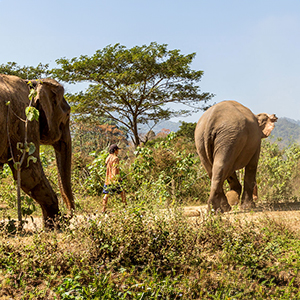
Mahouts, traditional keepers and trainers of elephants, were once revered in Thailand. Elephants were used as pack animals to help build village houses, or to bring rice in from the fields, and then in the logging industry through the 20th century. Those who could control these immense creatures commanded respect, and in rural communities the role of mahout was often passed down through families over generations.

After Thailand banned logging in 1989 many mahouts found themselves out of work, and unable to properly care for their charges. But this period coincided with a rapid growth in tourism, and very soon elephant camps where tourists could ride, feed and bathe elephants, and watch them perform tricks, became big business.

Much of elephant tourism in Thailand is exploitative, particularly riding camps, with both elephants and mahouts often mistreated. Mahouts are paid very little for what is a high risk, seven-days-a-week role with little job security. They can live in squalid conditions, in shacks with limited electricity and running water. Tourism, rather than an opportunity, becomes a poverty trap for them. This has led to a decline in the numbers of ‘generational mahouts’, those who have formed deep, lifelong bonds with their animals. In many camps the people responsible for controlling the elephants do not have as much training. They can be afraid of the elephants, which leads to abuse, and potentially puts tourists at risk too.

“Conservation needs to take into account the wider situation, the poverty trap,” Sarah continues. “Captive elephants coexist with people, so our ethos is if you don’t help the people you can’t help the elephants.”

Contact Us

Responsible Travel, Travel Team

Call us for a chat about our holidays. We are happy to discuss your holiday and help in any way we can. No bots, queues or awful hold music.

Responsible Travel, Travel Team

What does elephant watching in Thailand involve?

Our elephant watching holidays in Thailand take a community-wide approach that benefits local people, as well as the elephants. They’re an alternative to seeing elephants in hands-on environments which can have issues around control and safety. And, by providing skilled mahouts with a fair income, they help keep elephants out of the tourism industry. Family elephant watching trips are possible too, and safaris can be combined with community volunteering, as well as yoga retreats.

Our holidays are based in a small Karen village close to the border with Myanmar, a remote area within reach of both Mae Sot and Chiang Mai. There are few opportunities for employment beyond self-sufficient farming, so tourism income can have a significant positive impact. The village is surrounded by a 370km² forest where a small number of elephants roam freely, though the mahouts keep a close eye on their whereabouts to ensure they don’t leave the forest.

Forest safaris

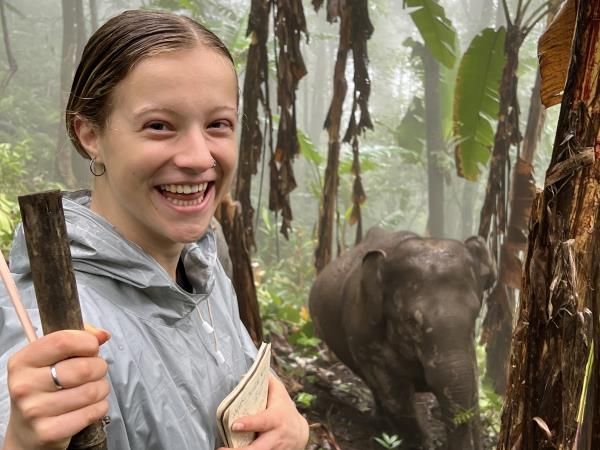
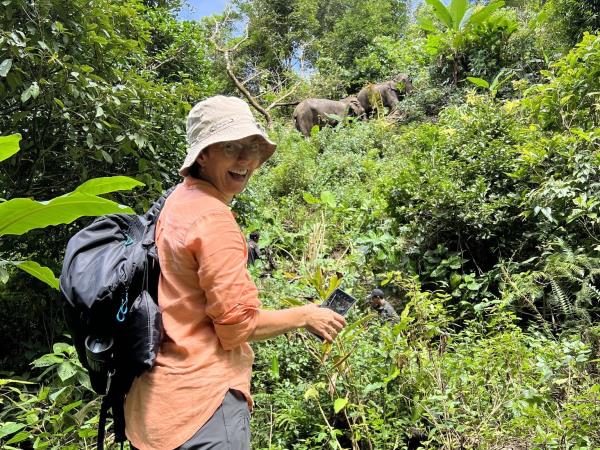
In the morning, one of the village’s mahouts heads into the forest early to track down the elephants. He will then stay with them, and radio his position back to another mahout who brings the groups out. You’ll spend the day with the elephants, following them at a respectful distance as they move around the forest. Elephants spend most of their lives eating (lucky blighters) though the younger ones are playful.

“It’s totally hands-off, no interaction whatsoever,” says Sarah. “Our elephants spend around 18 hours a day foraging, and we give them no supplementary food, which is a good indicator that they’re doing well and that this is a good place for them. They’re eating hundreds of different types of plant, as well as tree bark, herbs to heal themselves, and soil from riverbeds. A diverse diet like this is hugely important to their health and wellbeing.”

It's difficult to see other wildlife among the trees, but the forest is also home to gibbons and monkeys, barking deer, wild boar, porcupines, and pangolins. You’ll need to be in fairly good shape – though you’ll be walking at a relaxed pace the forest gets hot, and the ground is uneven.

Karen cultural experiences

When not with the elephants, you’ll spend your time in the village, getting a feel for day-to-day community life. You’ll be free to join in with the women of the village as they weave traditional Karen clothing and bags which they sell, or with the older men as they make baskets from bamboo.

Depending on the time of year you might help out with planting or harvesting coffee or rice, or help create fire breaks before the dry season – all activities that go on whether tourists are present or not. You can join in a cookery workshop, hike into the forest to learn about medicinal plants, or just sit around with a cup of mountain tea and get to know your hosts better. And the sunsets from the temple are fabulous, by the way.

Homestay accommodation

Visitors have the option of being accommodated either in a homestay with a local family, or a purpose-built guest house with a few more home comforts, that has been built at the top of the village. The Karen people here typically sleep on the floor, but if you opt for a homestay you’ll be provided with a mattress, as well as a mosquito net, in a private room. Expect either Western-style toilets or squat toilets depending on the house, and traditional bucket showers, which may take a little getting used to!

Wherever you stay, you’ll enjoy delicious homecooked Karen food throughout your trip. Think stews, curries, stir fries, all using vegetables foraged from the forest. Banana flowers are a particular delicacy, deep-fried to make tempura. Vegan and vegetarian travellers can be catered for just fine.

“We make a point of rotating the households that provide guests with food and accommodation,” says Sarah. “That way we ensure that everyone in the community benefits from tourism.”

Is this the future of elephant tourism in Thailand?

Elephant sanctuaries remain important because often the animals are physically or mentally damaged from working for years in tourism or logging and would struggle to survive in the wild. We recommend you only visit sanctuaries on a ‘no touch, observation-only basis’ – it’s safer for you, and it encourages sanctuary owners to let the animals have space from visitors.

But in an ideal world, all elephant tourism would look like this, with the animals in their native habitat, behaving naturally, and humans simply watching on from a distance. “It’s become too easy to see elephants in Asia,” says Sarah. “It shouldn’t just be treated as a right.”
Written by Rob Perkins
Photo credits: [Page banner: Mahouts Elephant Foundation] [Intro: Mahouts Elephant Foundation] [Elephant tourism in Thailand: Mahouts Elephant Foundation] [Forest safaris: Mahouts Elephant Foundation]