Doing a field guide course could be your first step towards a career pivot into conservation, or it could just be the wildest few months of your life.
The low morning sun makes it easy to spot the tracks – but whose are they? A leopard, yes, but male or female? What direction were they going, and how fast? Were they dragging a fresh kill along with them? Were they followed?
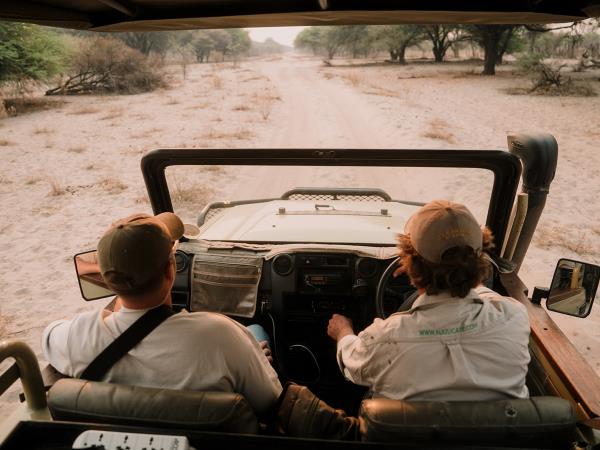
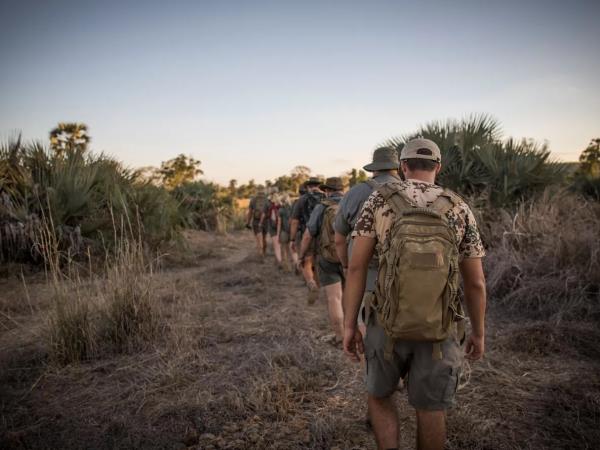
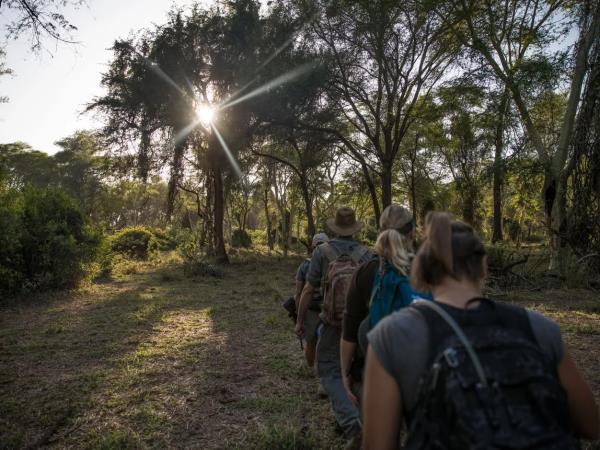
‘Track and sign,’ as it’s called, is on the syllabus in these intense field guide courses where you spend weeks in the Southern African wilderness.
It’s not just spoors you learn as a field guide, but astronomy, taxonomy, conservation, weather patterns, the name of every tree, and the call of every bird. You learn how to shoot a rifle, and how to drive off road (and get a car out when it gets stuck in sand). You learn how giraffe saliva covers the leaves of trees where they feed, and recognise the marks the smallest dung beetle makes in the earth as it moves.
You’ll be able to explain the six kingdoms and grassland succession, name the brightest star in the sky and the phases of the moon. There is no more thorough introduction, in terms of syllabus and nature immersion, to becoming a guide.
Springhare poo comes in cuboids, giraffe poo tends to be scattered, because it drops from a height. Lion poo is dark with the blood of its prey.
![]()
“It was two of the best months of my life, I fell in love with South Africa,” Daniel Kaul, managing director of our partner Natucate, did a two month guiding course on a whim, and it changed the direction of his whole enterprise; he decided to focus on offering more courses in Southern Africa.
The
one year field guide course involves 335 days of training and teaches you how to be a Southern African-accredited field guide with an internationally recognised qualification from the Field Guides Association of Southern Africa (FGASA). Alumni go on to found their own travel companies or pivot their careers to work in conservation.
There are shorter courses too: a
two month field guide course gives you FGASA Field Guide Level 1. You could also do a basic 1 month
field guide training – taking an exam at the end of this course also gives you a guiding qualification, FGASA’s NQF2, the minimum needed to be employable as a guide. Wildlife enthusiasts can also ask about shorter courses – just for fun.