Walking The English Way

This peaceful, spiritual 113km walking route goes south from the Galician coast to Santiago de Compostela, one of the world’s major pilgrimage sites. Completing an eight-day walking holiday along this Camino de Santiago route entitles you to a Compostela – a pilgrim certificate.

“A day on the camino is very slow – it’s a week in real life. It blows away every cloud, there’s nothing to do except eat, sleep, walk and talk.” Bronagh Carroll from our partner Magic Hill Holidays knows what she’s talking about. She has walked every single camino and she recommends the English Way for walkers who are looking for a quiet experience away from the crowds.

There’s a variety of scenery on the way. Unlike the last 100km of the popular French Way, the route of the much shorter English Way starts with coastal walking before turning inland, and there aren’t many people on the trail at all.

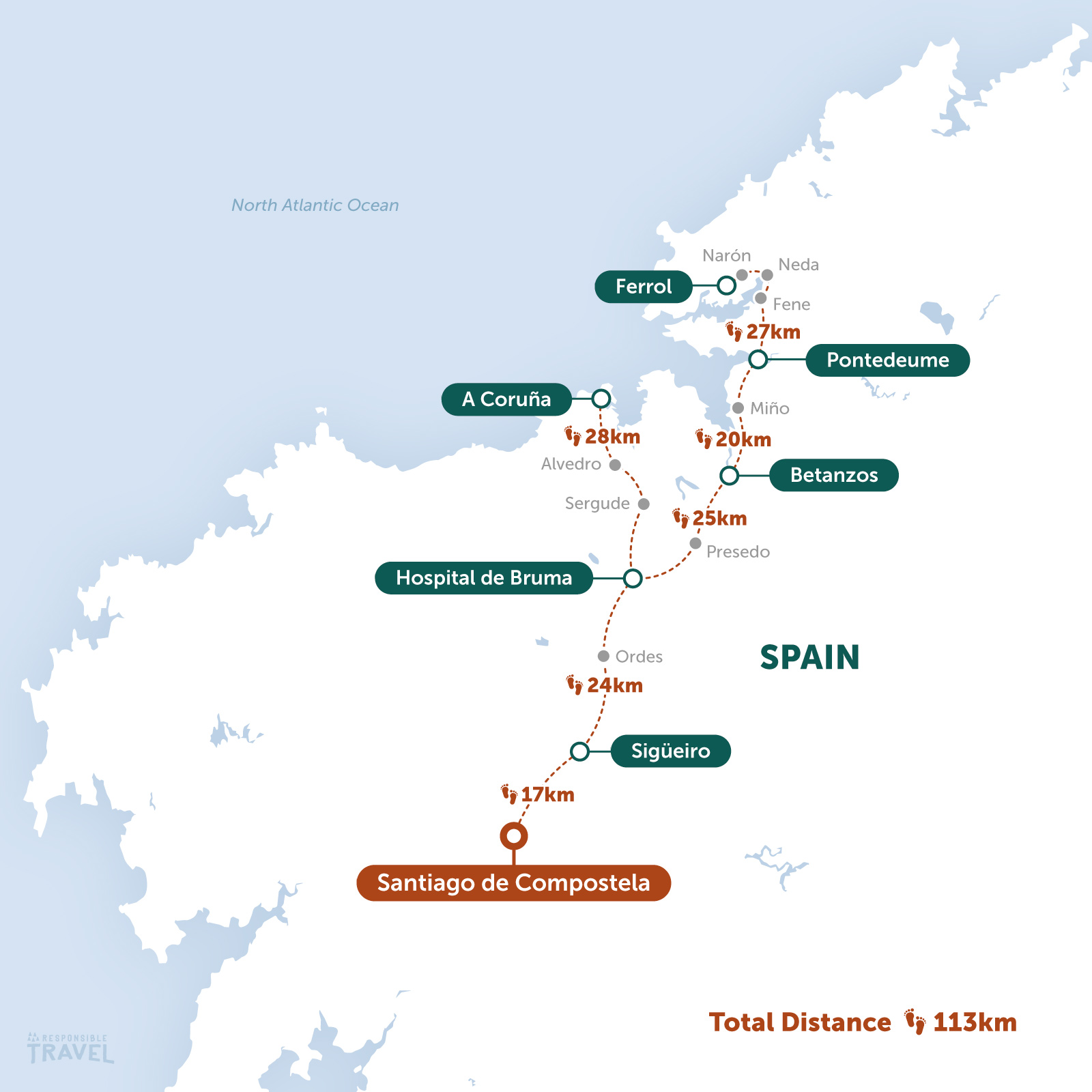
The English Way route map

The English Way of the Camino de Santiago map, Spain

Exploring the English Way

If somebody said to me, ‘I want a very quiet, meditative, monk-like experience where I do not want to be surrounded by anybody’ – I would say straightaway ‘The English Way,’
The Camino de Santiago is a network of pilgrimage trails across western Europe that converge on the Galician city of Santiago de Compostela, believed to be where Saint James is buried and therefore of major importance to Catholics around the world. Unlike most medieval trends (catching plague, wearing hose), walking camino routes is trendy today – numbers on all routes have been growing in the last few years.

A quiet camino for a walking holiday

“If somebody said to me, ‘I want a very quiet, meditative, monk-like experience where I do not want to be surrounded by anybody’ – I would say straightaway ‘The English Way,’” says Bronagh.

Despite its increasing popularity the English Way gets just five percent of all camino footfall each year – around 30,000 people of the roughly 530,000 who walk all routes each year. This route is as historic as the French Way, and it’s great if you want a contemplative camino experience but are short on time.

The English Way is the fourth most popular route to walk, trailing far behind the most famous, the French Way, and not as popular as the two Portuguese Ways – both coastal and non-coastal. It slips into the rankings above the Northern Way and the Camino Primitivo. As the camino network consists of at least 20 routes, fourth place isn’t to be sniffed at.

What makes the English Way English?

The name ‘English Way’ comes from the pilgrims who walked it. “In medieval times it would have been a pilgrimage for English, British, Irish, Scandi people would have come down on the boat,” explains Bronagh.

‘English Way’ seems fitting in other ways. At first glance this part of Galicia does look like other parts of northern Europe and the UK and Ireland – for one thing, it has changeable weather, bracken-covered hills under chestnut trees, rolling countryside and farms with small fields. But you’ll also get distinctly Galician vibes. There are the eucalyptus forests, which were planted under Franco (born in Ferrol, where this camino starts). There’s also the food, which ranges from bocadillos (large sandwiches), to raxo (garlicky pork loin, served with chips), and tapas.

Medieval walkers of this route weren’t confined to those from the British Isles – Irish, Scandinavian, German and French pilgrims used it too – anyone who wanted to arrive by ship on the coast of northern Spain.

Today it attracts walkers of all nationalities. Brits are only the sixth most common walkers: Spanish pilgrims are most common, given this is their stomping ground – though, as Bronagh explains, most choose to walk in July and August. American pilgrims come in second.
The kindest people who have crossed my path have been on caminos

Finding a camino family when you walk

“You’ll meet people, yes you will… but probably under 10 a day,” says Bronagh. Being a quieter camino has its good and bad sides. For many, walking a camino means finding a ‘camino family’ – people on the trail who you might walk with for a short while – and then catch up with later on the trail, at an albergue (inexpensive bunkhouse for walkers) – or in the main square at Santiago itself for an emotional reunion. There are fewer walkers on the English Way, meaning fewer opportunities to find a family – though the people you do meet might be more willing to interact.

Speaking with other walkers is one of the highlights of walking any camino. “The people you meet, the conversations you have are the most special,” says Bronagh. “You get deeper conversations than you get on your average day to day: intellectual, deep conversations. The kindest and most educated people who have crossed my path have been on caminos. They attract a certain type of person.”

Hiking along a living camino

Caminos are living things. The camino you walk today is the same as the camino walked thousands of years ago – but it has also evolved. Sections re-route, sections improve – roads are phased out to include more purpose-built paths. The English Way is now well-signed. You’ll follow the flechas amarillas (yellow arrows) and distinctive concrete markers that count down the distance to Santiago. You’re walking on large and established paths. The Camino Ingles has a good proportion of its path on asphalt – which isn’t to say that it’s unattractive: lots of the time you’re walking alongside forests. “Tarmac-covered sections will be country roads with no traffic on them – but any time you leave or enter a town you’ll be on a road,” points out Bronagh.

The English Way has two starting points – one in the city of A Coruna and one at Ferrol. Walking from Ferrol is a distance of over 100km, which qualifies walkers for a Compostela, and this is the route we take. In 2016, the Cathedral of Santiago allowed walkers to get a Compostela if they walked from A Coruna, providing they had previously walked 25km or more of a spiritual route with pilgrim passports – like the Celtic Camino in Ireland.

Pilgrims of yore reached the starting points of the English Way by boat. Now there’s no ferry to Ferrol, and walkers often fly into their end point at Santiago before taking a train or taxi to the start. “In the past the start point was the front door of your house,” says Bronagh. “In Ireland’s case the main port of call would have been in Dublin, then you’d head down to Plymouth. And these days we don’t have to walk back. Back then it was a month’s if not a year’s undertaking.”

Medieval pilgrims, like us, often paid for services that transported and helped them on their way. Paying for someone to assist your camino is a time-honoured tradition. Using a service like ours means you can focus on the walking and the meditative side of this route, rather than the logistics.
Don’t let planning get in the way of pilgrimage – offloading the logistics to a company leaves you free to contemplate, embrace and cherish your time on the camino.

Why book a tailor made English Way walking holiday?

It’s 4.30 am and someone in the bunkhouse is rustling through their bags – the rustle spreads – others have woken up too – after all, whoever makes it to the next bunkhouse first is guaranteed a bed for the night. Beds in inexpensive albergues along camino routes are offered on a first come first served basis – and there are fewer to choose between on less well-trodden routes like the English Way.

“It’s not for the traveller who is a highly controlled individual,” says Bronagh. “Or people who don’t have time to organise it. It takes time to put together camino trips in general – so if you’re looking for a hassle-free camino, book with a company.” Don’t let planning get in the way of pilgrimage. The walking might find you in solitude, but you’re not alone on this route.

An organised camino means having hotels organised for you, including taxis booked for when the best hotel is a little off the official route, as well as 24-hour phone assistance and detailed notes.

Our top trip

The English Way walking holiday

The English Way walking holiday

8 day walking trip through beautiful, rural Galicia

From €750 to €795 8 days ex flights
Tailor made:
This trip can be tailor madefrom the end of March to mid October

Contact Us

Responsible Travel, Travel Team

Call us for a chat about our holidays. We are happy to discuss your holiday and help in any way we can. No bots, queues or awful hold music.

Responsible Travel, Travel Team

Walking the English Way, day by day

Your journey starts in Ferrol – start here so that you can make your route the necessary 100km long. “The first day is all along the coast,” says Bronagh. “It’s one of the nicest sections really. You walk along to Pontedeume – there’s a very nice long medieval bridge into the town.”
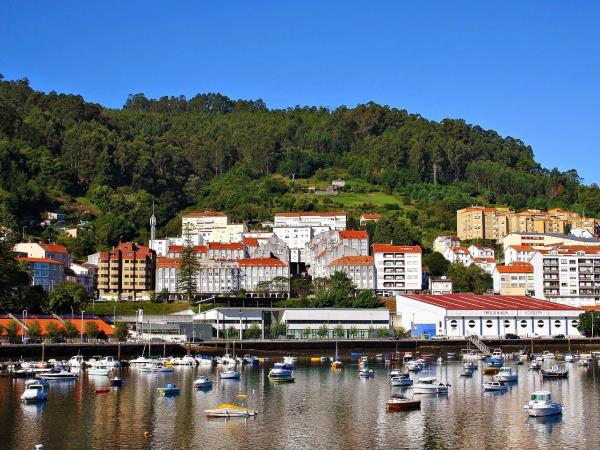
Pontedeume is a town on the mouth of the Eume river. Here there are lots of local restaurants to try but save some room… after the next day of river and sea views you get to your next stop, tortilla town…

How do you like your eggs in the morning? If you like them runny, head to Betanzos, where the tortilla de Betanzos is famously served deliciously runny. The historic centre is worth a wander, too.

“From that point onwards it’s rural: towns, forest, villages,” says Bronagh. You reach Hospital de Bruma and you’re in a very quiet area. In the last two days before Santiago, there is less accommodation and fewer facilities. Bruma is the point where you might start meeting pilgrims walking the English way from A Coruna.

Sigueiro is the last town before Santiago – so expect a contemplative, or exciting, or sad last night, knowing your walk will all be done tomorrow.

Arriving in Santiago de Compostela and entering from the east, as the French Way does, as you approach the cathedral that is your end point you’ll hear Galician bagpipes playing and feel a tide of emotion swelling in the crowd.

Stick around in Santiago for a night and catch a church service in the cathedral the next day – to truly take in the emotions of having completed this oh-so spiritual camino route.

Our English Way walking holidays: in summary

The English Way is 113km and takes five to six days of walking, with an arrival day at the start and a free day in Santiago at the end. The walk starts in Ferrol and ends in Santiago de Compostela, stopping in Pontedeume, Betanzos, Bruma, Sigueiro and finishing in Santiago, walking between 17km and 27km a day. You can get to the start of the walk by train from Santiago or taxi from Santiago de Compostela airport. This is a quieter camino with fewer facilities than other routes. The route is undulating, and on a mix of terrain, including paved roads. There are albergues along the way, but you may prefer your own accommodation – so you don’t wake up with some keen bean’s 4.30am alarm. Make sure you’re getting your credencial (pilgrim’s passport) stamped at Ferrol and then each day for the duration of your walk so that you qualify for your Compostela – it proves that you haven’t simply hopped in a taxi.
Written by Eloise Barker
Photo credits: [Page banner: Oscar Taylor] [Exploring the English Way: Viinikkala] [Finding a camino family: Jose Antonio Gil Martinez] [Pontedeume: antonioxalonso]