Cycling & tiger safaris in India

Finding peace in the (almost) tigerless outskirts of Kanha National Park

One of the biggest appeals of cycling in the centre of India is the promise of tigers. You won’t run into them when on your bike, but they are habituated to jeeps so you can spot them on a safari. But whilst tigers might pull you to the centre, it’s life in the margins of the park that might have you coming back.

“This is the textbook example of an ecosystem,” Catherene is saying.

We are on a tiger safari, staring at swifts. There are hundreds of them, and swallows too, looping, circling, impossible to track with binoculars – though we try. The jeep is stopped; the driver puzzled. There are no tigers here. Fifty metres away, the spotted deer are grazing as quiet and calm as ever.

Below the swifts, Catherene Christian, a naturalist on our tiger safari and cycling tour, points out the globe skimmer dragonflies. And then, high above, we finally spot the unmistakable shape of a bird of prey – a black, ragged outline, as though someone has cut a piece out of the sky. It’s a rufous-bellied eagle. Catherene is excited; she’s not seen one in Kanha National Park before.

The bird’s lazy circles complete the column of life which is whirling upwards, a tornado with us in its centre.

This trip to Kanha National Park in Madhya Pradesh, Central India, has been an exercise in circling quarry. Throughout, we have taken the most indirect route, taking our time in reaching the centre.

Tigers & cycling

Most people come to Kanha National Park for four days of back-to-back morning and evening jeep safaris. This is one of the best places in India to see tigers. There are around 150 of them in the park – and scores of jeeps on the hunt.

Shergarh Tented Camp, where we started our trip, is a base for many safari-seekers who come to the central Indian region of Madhya Pradesh. A family of langurs hang out on the roof of the camp and, after dark, a shone torch shows chequered keelback snakes in the dry river bed and jungle owlets huddled in the trees.

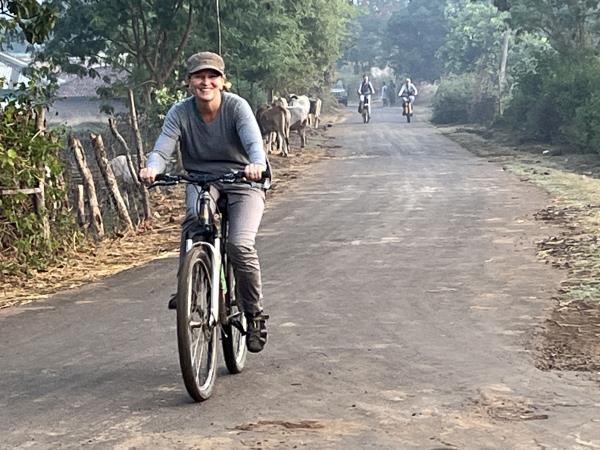
We were here with an alternative plan – one which almost bordered on the obtuse. Rather than heading into the park, we were going around it, on a cycle ride that circumnavigated its buffer zone.

This cycling trip was mapped by Sophie Hartman, director of our partner Holidays in Rural India, and by her friend Katie, who co-runs Shergarh.

“My trips have a wildlife focus,” says Sophie, “but I’m interested in communities, the ones who are impacted in positive and not positive ways by living next to a national park.”

I remember when I first heard of the trip, I thought to myself – sure, but I want to see tigers. And I really thought that I did.

The elusive tiger

I know a lot of people who haven’t seen tigers in India. In fact, a lot of tiger safaris are about setting expectations low. At the same time, you’re bombarded with the sense that tigers are a whisker away from the moment you arrive in Mumbai. Everyone seems to have a tiger as the photo on their phone lock screen. They stare from billboards. They have been taken out of Mumbai Zoo: they were getting sick – replaced, according to our guide, “with the obvious choice – penguins!”

The tigers come at night. Every evening, in front of a fire at Shergarh Tented Camp, the guests pull out their phones, their iPads, and bring up their photographs. Tiger safaris are a serious business. The trips are tightly controlled, heavily regulated, and must be booked in advance. Because only a limited number of GPS-tracked jeeps can enter the park at once, people are advised to secure their seat in a jeep four months prior to their visit. Showing us her tiger photos back at the lodge, one of the other guests was berated by her husband for not cropping out all the cars in the background.

Wendy, another traveller at Shergarh Camp, has come here multiple times and never seen a tiger. When she finally does, she doesn’t understand what she is seeing. “I thought it was a painted board,” she says. “I thought someone had placed a painted board next to the tree.”

For days since I have arrived in India, I have felt permanently at one remove from tigers. Wherever we went, it was as if there was, to misquote author Arundhati Roy “a giant, tiger-shaped hole in the universe”.

Circumnavigating Kanha by bike

For the first three days of the trip, the park was to be a negative space which we would skirt by bike. The closest we would get in the first few days was the buffer zone, with its tantalising, unseen leopards.

The mapping of the cycling route has been no mean feat.

“It wasn’t a Google Map exercise. You’d cycle and get to the forest boundary and someone says you can’t go any further,” says Sophie. “We must have cycled 1,000km to map 350km worth of cycle routes.” Maps are deliberately vague in the area to deter poachers.

The resulting route – on roads, off road and sometimes very intrepidly, including a fording of the wide and beautiful Banjar River – was wonderful. Now, there are two Indian-made electric bikes in the fleet, which can make short work of any hills or lumpy terrain.

By cycling, I began to realise that it is on the edges of the park that life flourishes. Here, connected by narrow roads, are hundreds of tribal villages, inhabited by the displaced Baiga and Gond (or Koitur) communities.

Our top trip

Tiger cycling safari in Kanha, India

Tiger cycling safari in Kanha, India

Gentle Cycling in the Secret Heart of India

From £2950 9 days ex flights
Small group travel:
2026: 28 Nov

Contact Us

Responsible Travel, Travel Team

Call us for a chat about our holidays. We are happy to discuss your holiday and help in any way we can. No bots, queues or awful hold music.

Responsible Travel, Travel Team

Travelling between tribal villages

Under Indira Gandhi’s Project Tiger, which aimed to kick-start conservation of Bengal tigers in the 1970s, millions of people were moved out of newly establishing tiger reserves.

Subsistence foragers who lived off the forest were given barren land and expected to stay out of the reserves. Tigers and humans could not coexist.

Kanha National Park is famous for its vast meadows where deer graze and tigers loll. These are the sites of former villages – up to 28 of them, from which people were evicted to outside the park limits. You can see the ghostly footprints of former houses – village-shaped holes in the park.

Since the Scheduled Tribes and Other Traditional Forest Dwellers (Recognition of Forest Rights) Act 2006, the government has promised to do more to help disadvantaged tribal people, but there’s been little evidence of improvement. In the vacuum, some initiatives have stepped in, including Earth Focus, an NGO, and PashooPakshee, a women’s craft co-operative. Shergarh Tented Camp employs 95 percent tribal peoples – well above the minimum requirement for tourist lodges.

The new villages outside the park are beautiful: cow dung and mud houses, painted blue, have glassless windows and low roofs. Villagers grow vines of bottle gourds over their cowsheds, whilst saris hang over the wattle fences to dry. The rice harvest is piled in Van Gogh-worthy stacks, completed with protective woven bamboo hats.
Kanha National Park is famous for its vast meadows. These are the sites of former villages.
Yet, with low employment, historically poor education outcomes, and low life expectancy, village people are suffering. Malnutrition is rife.

The first night we arrived at Shergarh, we could barely sleep – the tiny village next door was blaring music for a funeral and did so long into the night. The next day we cycled past another funeral in progress – a throng of people milling around the doorway of a home. Death was everywhere. There were stories of dreadful accidents. The work – carrying firewood, stacking hay, digging, chopping – was backbreaking. Legends of man-eating tigers are often the least of the worries of a displaced tribal community.

Visiting another tourist camp, our host recalled once seeing people evicted into corrugated metal shelters in summer heat. “I’ll never forget it,” she said. “People were dying. Babies were dying.”

Villages cannot afford plastic to cover their crops. We had unseasonal rain for two days when we cycled – a suspected product of climate change, which kept us cyclists cool but threatened to rot away the harvest.

As we cycled, we saw government-funded brick buildings stood next to some of the traditional homes. Families chose to remain in their traditional homes. Nothing the government built seemed to have replaced the fantastic insulating and cooling properties of their mud-and-dung houses. They use the brick buildings to store rice instead.

Life on the edge of the forest

The villages came in quick succession on our route, strung together by tracks and roads, and we got used to the rhythm of rural life – the coming and going of the cattle herders, their charges slowly parting around our bicycles, so that we were surrounded by low bells and bony rumps.

We interrupted cricket matches, and spoke to schoolteachers as they made their way back from work. We used sticks to dislodge unripe tamarind from the trees and drank chai, freshly strained and piping hot. We stopped to chat with a man lying out in his yard, his daughter standing on his back, massaging a difficult knot with her feet. We visited our driver’s uncle’s house.

Sophie has made connections with an agricultural project run by Earth Focus, an NGO that teaches farming techniques to villagers. Standing on what was once barren land, surrounded by mango trees, guava, tall bamboo and beds of turmeric, we met the first villager who agreed to participate in 2019.

Sophie, amazed, found pictures on her phone of how the site had looked just a couple of years previously. We compared the barren riverbank to its new self. Life truly was happening in the margins.

The farmer smiled when we showed the old photos. “He said thank you for visiting,” said our interpreter. “He said come again next year.” Everyone we had met had been almost heartbreakingly self-effacing. “Come again next year,” he said, “and you will be even happier.”

Signs of tigers

But Sophie knew that no one could come here and not go on a tiger safari. We had four safaris built into the trip: two in the morning and two in the evening – plenty of opportunities for tigers. As the drives approached, the build-up, which had started back in Mumbai, became almost unbearable.

On day six, we saw claw marks on a tree; on day seven, we woke up and were told the camp guard had heard roaring in the night. Day eight brought a footprint in the sand – the pad of a tiger’s paw is comically round and large. It looks like a teddy bear’s.

On one tigerless – and rather wet – safari, our driver and naturalist were laughing together, imagining the tigers all snuggled up somewhere warm together, out of sight. At first, I was annoyed – and then my imagination began to run with it.

Another displacement was happening. I found myself looking forward to getting on the bike every day – to bombing down the road. I wasn’t on a park ranger’s list. I wasn’t accounted for. I didn’t have to keep my arms inside the vehicle at all times. I was free. In the forest, always over my right-hand shoulder, the tigers were snoozing undisturbed.

When we finally saw our first tiger, it was in a state of frenzied intensity. It had rained for three days and sightings had dropped.

But the rain cleared. In the fresh park, the tigers were roaring out to each other – the scent had washed off the trees and they wanted to find each other again. After half an hour, the tiger burst out of the bush 20m in front of us like a star out of a limo, larger than life with its train of fur. It walked alongside our car as we reversed away from it for a full two minutes, impossible to describe in its size and colour.

The jeep fleet jammed; cars locked wingmirrors. Passengers were hysterical. It was surely one of the most intense sightings of any animal I have ever experienced.

“This is my favourite thing,” said Sophie, as the sun set and we cycled home from a village visit a few days later. The day of work was over and people were leaning in their doorways, babies in their arms. Colours were draining out of the landscape and bleeding into the sky. On the horizon, the high trees of the national park were turning black. I had to agree. The tigers – breathless, stressful – were once-in-a-lifetime encounters, I knew that.

But I could cycle here forever. “Come again next year, and you will be even happier”: I had found my centre.
Written by Eloise Barker
Photo credits: [Page banner: Davidvraju] [Intro: Srivenkata Subramanian] [The elusive tiger: Gaurav Sharma] [Cycling: Vivek.drajan] [Kanha National Park: Honza Soukup]