Sail across the Atlantic

Traditionally, an anchor tattoo meant that you’d crossed the Atlantic Ocean. Today, the feat remains one of the biggest you can undertake by boat. We find out how you can take part – new ink optional.

“Look, sailing is all about emotion. It’s a ridiculous way to travel. If you want to get across the Atlantic the best way is to fly. If you want the romance of being on a boat, you go on a cruise. But to be in a plastic bucket, going at eight miles an hour, often in slightly the wrong direction – why would people do that, if it wasn’t for the emotion of it all?”

Bruce Jacobs is managing director of Rubicon 3, who run sailing expeditions across the Atlantic.

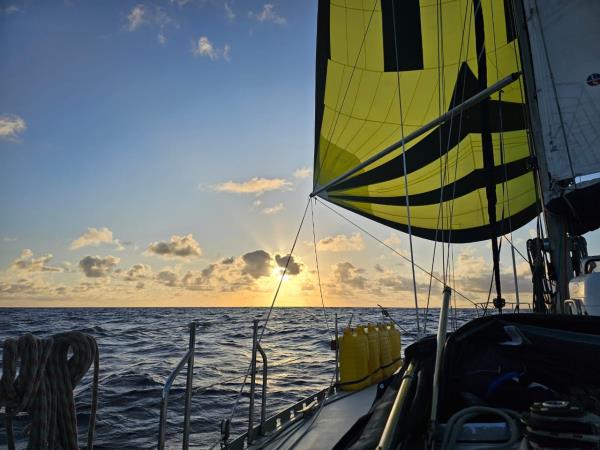
Crossing this ocean is no mean feat. Whilst the record for an Atlantic crossing by a sailing vessel is just three days, for most boats it's normally a good three weeks of sailing, much of it without land in sight. In fact, the first sight of land after deep ocean sailing can feel miraculous.

It's a route that is marked by miles and miles of featureless ocean and lots of long watches on deck. You'll celebrate with an Atlantic crossing party at the half-way point. For want of any physical markers, you might simply have to log the longitude, and dress up for the occasion.

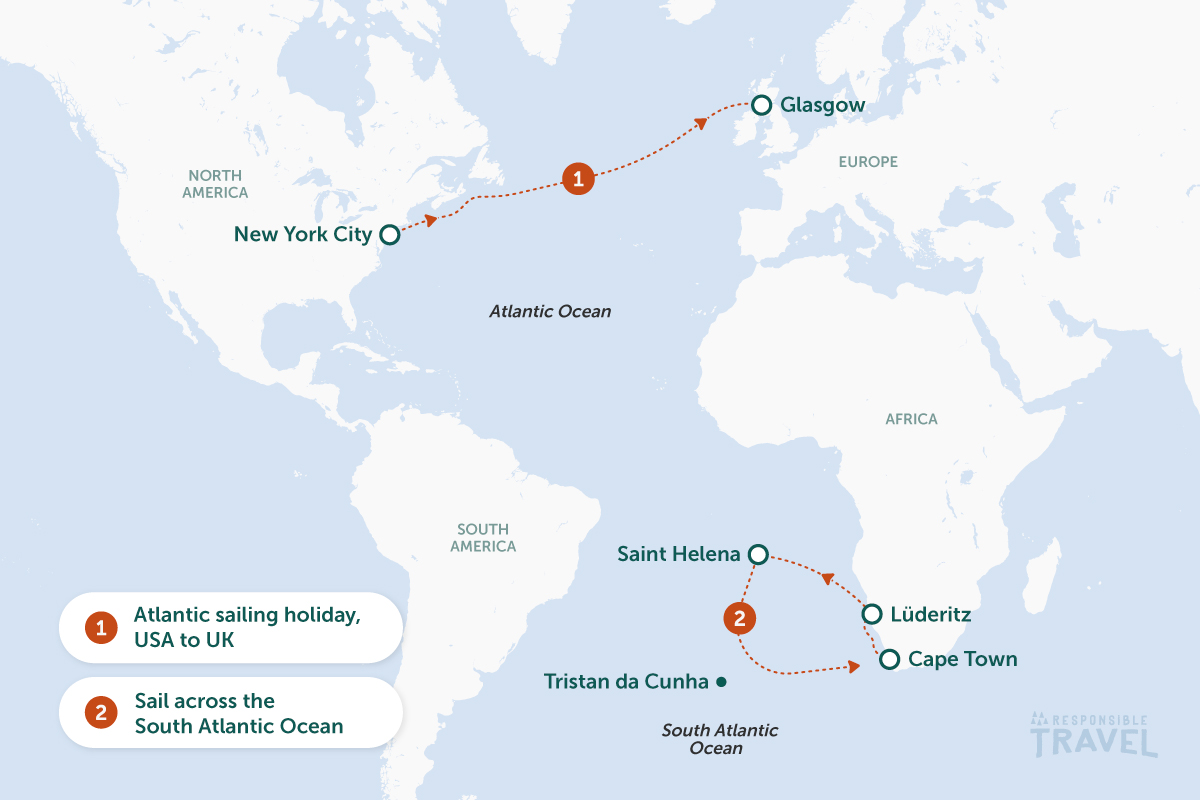
The classic route traditionally taken across by races and by leisure sailors is from the Canary Islands to the Caribbean. There's also a northern route to cross west to east, taking in Canada en route. You can also sail in the south Atlantic from Cape Town to St Helena

Sailing across the Atlantic is a true expedition, full of unknowns and adventure. How long it takes, and the route you follow is completely weather-dependent. It’s a month at sea – sometimes more. Given the enormity of the task at hand, it’s hard not to become philosophical when talking about the trip.

“Crossing the Atlantic is the most extreme and in-depth manifestations of that process of working with nature,” says Bruce. “You are crossing one of the world’s five great oceans using just the wind and your skills and your energy. The value is in that – looking at the horizon when you’re a thousand miles from the closest bit of land, seeing sunrises and sunsets and the millions of stars at night.

“And you’re totally in the hands of nature. In the mountains you can get to shelter. In the ocean you are there… you have to be at one with it – there’s nowhere else to be… That’s an emotional and a deep experience for people.”

True adventures don’t just try the body, they challenge the spirit – as they should.

Our top trip

Cape Town to St Helena sailing expedition

Cape Town to St Helena sailing expedition

Cross the South Atlantic ocean with a world class skipper

From £5995 21 days ex flights
Small group travel:
2026: 12 Oct
2027: 1 Mar, 10 May, 26 Jul, 25 Oct

Following famous wakes

Crossing the Atlantic is a journey with a lot of historical baggage – it’s a voyage that might have first been undertaken by Vikings, but by the 16th century was associated with colonial conquest and exploitation, and then the mass movement of enslaved people; the Atlantic was the location of the horrific Middle Passage, during which many died.

Starting with the Mayflower in 1620, migrant peoples have undertaken the crossing to escape persecution and poverty and seek better lives in America. This continued into the golden age of steamships, which turned the transatlantic voyage from a risky ordeal into a cruise. The Atlantic crossing became a thing of splendour; high end hotel interior designers created First Class Lounges filled with marble, tapestries and gilt.

Commercial flight has made crossing the Atlantic in anything other than a jumbo jet an exercise in making a point – the stuff of World Records, nostalgia, or, in the case of Greta Thunberg, climate protest. And, for some, it is one of the last great adventures.

Wide Sargasso Sea

The Atlantic is as meticulously mapped as any other area of the world, with particular features that you might cross without comment, if it weren’t for looking at a chart. There are features of the wind, like the doldrums – the commonly becalmed area at the equator; the horse latitudes, above and below the equator, which have calm winds, and the westerlies, stronger winds further north and south. The Sargasso Sea is part of the Atlantic named because of the proliferation of Sargassum seaweed in this area. This mysterious area of ocean might look like anywhere else on the blue planet, but it’s where – and no one knows exactly why – the world’s eels come to breed: mysterious indeed. You’ll also cross the longest mountain range in the world without realising it: the Mid-Atlantic ridge.

Atlantic sailing routes map

Atlantic sailing routes map

Contact Us

Responsible Travel, Travel Team

Call us for a chat about our holidays. We are happy to discuss your holiday and help in any way we can. No bots, queues or awful hold music.

Responsible Travel, Travel Team

How do you sail across the Atlantic?

Thousands of nautical miles, long night watches, sunsets, day breaks and endless wave-breaks.

How experienced do I need to be?

It’s best if you’ve done a couple of weeks of previous sailing before taking part in this trip. This is so that you know that sailing is for you! Luckily we have lots of sailing holidays that could be suitable tasters so you can see whether seasickness is going to be a problem and whether you'll enjoy 'blue water' sailing: sailing without land in sight from horizon to horizon.

When you first join your boat you’ll be given a safety briefing, and then the next few days you will do some training onboard close to shore so that you can literally learn the ropes before setting off into the ocean.

Solo travellers

Solo travellers are especially welcome; most people join solo, so you’ll feel completely at ease if you come on your own. The living spaces are very communal, so you will be fully integrated into the crew.

Different Atlantic routes

The classic Atlantic crossing goes from the Canary Islands to the Caribbean. This is the route taken by racing yachts, and it’s usually characterised by a helping hand from the north-easterly trade winds.

From North America to Europe, your route takes you further north up the east coast of the States and on to stop at Nova Scotia and Newfoundland in Canada before making the jump across the pond. You’ll be catching the westerlies – winds that typically blow west to east.

You can also sail in (but not go as far as to cross) the South Atlantic, between Cape Town, St Helena and Tristan Da Cunha. Going back to Cape Town entails a round trip of around 5,000Nm.

ARC Races

Every year, 200 or so yachts gather in the marina of Las Palmas, Gran Canaria. They’re courted by fleets of vans filled with provisions on the docks, and crews assembling, ready to sail the 2,700 nautical miles across the Atlantic. Their destination? St Lucia in the Caribbean.

The Atlantic Rally for Cruisers, or ARC, has been running since 1986 with a wonderful slew of international crews. All the yachts are subject to stringent safety checks before they depart, and the rallies provide a supportive and safe environment– crews often include children, as sailing is often a family affair.

Your floating home

When you cross the Atlantic, you’ll sail on a yacht that has been specifically designed for ocean-going. Around 20 metres in length – or 60 feet – Clipper 60s were used in the Clipper Round the World Yacht race before being replaced in the 2000s by Clipper 68s and later Clipper 70s. Arguably, these are some of the best yachts for offshore sailing ever built, and ex-racing yachts have been repurposed as expedition vessels.

Below deck

Below deck, there’s shared sleeping space, toilets and showers, and a small communal area. These boats are not designed for people to spend much time below. Most of the time on a voyage you’ll either be up on deck, or you’ll be sleeping in your bunk. Everyone gets involved in cooking meals in the kitchen; there’ll be a rota.

Keeping watch

Speaking of rotas – boats sail on watch systems, as there always have to be crew on deck looking out for possible obstacles, manning the helm and logging the journey. You’ll be given time on and off watch (four hours on, four hours off is traditional. Our partners often do three hours on and six hours off, which is more relaxing!). You must stick to the schedule, no sleeping in – someone will be sent down to wake you up!

Staving off seasickness

Seasickness is a natural reaction to a bumpy journey, but sailing boats are arguably less likely to make you nauseous than motorboats. Seasickness is most likely to strike if you are below deck, unable to see the horizon, especially if you’re (and I'm speaking from personal experience here) bent over, cleaning something off the floor.

If being up on deck in the fresh air and looking at the horizon doesn’t fix it, then ginger (biscuits, tea, or stem straight from the packet), acupressure bands, and seasickness tablets can all help. If all else fails, lying horizontal in your bunk usually gets rid of it entirely.

Best time to go

Every year around November, the Mediterranean empties of yachts as boats of all sizes do the so-called ‘milk run’ to the Caribbean, avoiding the European winter in favour of the balmy tropics. Just so, all Atlantic journeys tend to take place outside of the June-November hurricane season, which affects the Caribbean and the east coast of North America. So if you’re sailing east to west you’ll be leaving after November, and if you’re sailing west to east, you’ll leave before June – most boats leave in April and May. If you're sailing in the South Atlantic from South Africa to St Helena, our trips depart between March to October.

Hello, Pitons

If you do the classic Atlantic route from east to west, you’ll know when the end is in sight, because of the extraordinary sight of two volcanic plugs in the offing.

“Seeing the pitons of St Lucia appear over the horizon – that’s a very powerful experience,” says Bruce. This geographical marvel is marvellous indeed – after thousands of nautical miles, long night watches, sunsets, day breaks and endless wave-breaks, it’s time to crack out the rum punch and relocate your land legs.
Written by Eloise Barker
Photo credits: [Page banner: Rubicon 3] [Intro: Rubicon 3] [How experienced do I need to be? : Rubicon 3] [Your floating home: Rubicon 3] [Best time to go: Christian Lendl]