

Japan multi activity tours

Hundreds of years ago, when samurai warriors would accompany their feudal lords along the Nakasendo Way between Edo (Tokyo) and Kyoto, they would be heavily armed in case of ambush. When you walk a section of the route today, you don’t need to bother with a sword, however you might want to carry a kuma-yoke-suzu – an anti-bear bell. Japanese black bears are shy of humans and usually prefer to hide themselves away in the forest. But walkers will often attach a bell to their belts anyway. It doesn’t hurt to give a little tinkle every now and again, just to reduce the chances of an unexpected encounter.

Unexpected encounters of the welcome kind are the essence of our Japan multi activity tours. They visit the iconic destinations like Osaka’s Dotonbori district, and the Fushimi Inari Shrine of Kyoto, but they also take you into the countryside, to places, and experiences, that will be less familiar – sometimes, even to your tour leader.

“I love exploring new areas with my ‘packs’,” says Karen Zhao, product manager with our partner Intrepid Travel. “It can be a bit daunting to visit somewhere fresh, where you maybe need to think a little more about where you eat, for example. But sharing the adventure with the group is really exciting. I always want to see new and different things and I think our travellers feel the same way.”
I always want to see new and different things and I think our travellers feel the same way.
One of the great pleasures of our multi activity holidays in Japan is the sheer variety of experiences you’ll enjoy. Depending on the day you could be hiking, cycling, and kayaking, but many trips utilise public transport, so you’re getting from place to place by ferry, bus, metro, and bullet train. You’re staying in locally owned hotels (some holidays feature a night or two in a traditional ryokan guest house). And often you will be spending time in places such as the cities of Onomichi and Toba, or the small mountain village of Koguchi, that, while certainly not unknown, don’t feature in many classic Japan holiday itineraries. All of which means that, while getting out and about in nature is very much the focus of these trips, they can be very culturally immersive as well.

Escaping the cities for the countryside as much as possible also means that our holidays help to preserve aspects of Japanese cultural heritage through tourism income. These could include historic walks like the Nakasendo Way and the Kumano Kodo, and the communities they connect; the Shimanami Kaido bicycle route, and ancient traditions such as pearl diving by the ama (sea women) of Toba.

What does a Japan multi activity tour involve?

Hiking

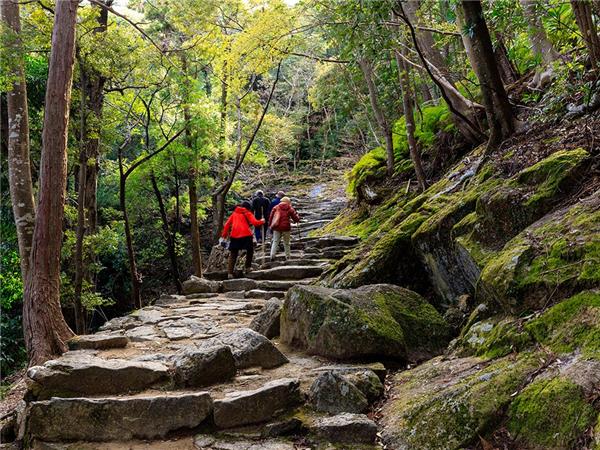
The one essential to pack for our holidays is a good pair of walking boots or shoes, because on many trips you will be hitting the trail regularly, and there will be a few ascents that require decent fitness. On the legendary Nakasendo Way for instance (full length: 530km) you might walk a well-maintained section through a forested area between Tsumago and Magome. These traditional post towns are where tired travellers found food and rest in centuries past, and a steaming bowl of ramen is still easy to come by today.

Reaching Kyoto you can give your calves a workout by summiting Mount Daimonji, which is one of the best short hikes in the city, offering panoramic views across Kyoto and beyond. And most of our multi activity tours in Japan will visit the Fushimi Inari Shrine with its instantly recognisable orange torii gates. Groups can escape (most of) the crowds and enjoy a more peaceful atmosphere by hiking up the hill.

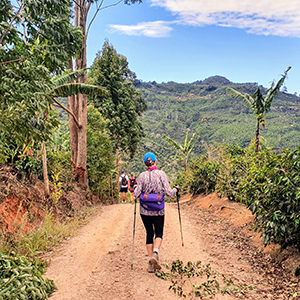
And from the picturesque mountain village of Koguchi your group will hike part of the Kumano Kodo, which is one of only two UNESCO World Heritage-listed pilgrim routes in the world. Expect a steep climb for the first three hours or so, as the route rises over 800m into the forest. A set of foldable walking poles can be a good investment, as can a few practice hikes in the weeks before your holiday.

Cycling (& kayaking)

A typical multi activity tour will also see you spend a few days in the saddle– nothing too strenuous, but good-quality rental bikes are provided, along with helmets of course. Cycling is a fantastic way to get around because you can see much more than you would on foot, but you’re still surrounded by nature.

One popular route is along the Shimanami Kaido, a 70km toll road that connects six small islands between Honshu and Shikoku, affording lovely views of the Seto Inland Sea as well as shrines, little beaches, and fishing villages. Cyclists have their own lane, which diverges from the expressway on the islands. You can ride across three of the islands in a morning at a laidback pace, arriving on Ikuchijima in time for lunch. Then you can swap bikes for kayaks: pop on life jackets, and go for a paddle off the coast.

Kyoto’s markets, temples, shrines, and its geisha district Gion are familiar fare on our trips to Japan, though no less impressive for it. On our multi activity tours, you can leave the city behind for a day by cycling. Following the Kamo River to Demachiyanagi, you can stop at a series of temples to explore Zen Buddhism, your tour leader a constant source of interesting facts while showing the way.

Cultural connections

The experience of being in a small group of 12 or so people is much more enjoyable than a larger, ‘follow the flag’ coach group. Not only in how guides connect with you, but in how you are able to connect with local people and their culture.

In Japan, you’ll often dine at small, intimate restaurants. These are the type of places where you might be sharing the counter with a group of hard-working ‘salarymen’, passing the sake around as you watch the chefs at work; or where the owner comes out of the kitchen to greet you. In Kyoto you can spend a few hours in a traditional bathhouse and get chatting to any number of local people enjoying a soak and a steam.

Karen takes a deep breath before running me through a few of her food recommendations. “I love tonkatsu, which is the deep-fried pork steak you get. Then ramen, teriyaki, and okonomiyaki, which are the pancakes you get in Osaka – they’re a hugely popular traditional street food. Oh, and also all the weird and wonderful Kit Kat flavours you only get in Japan like strawberry, black tea, or watermelon...” I had to interrupt Karen at this point, because my mind was wandering off to my own happy memories of steaming bowls of ramen in Japan. I love ramen. As you’re reading this, there is a very good chance I am out there somewhere, thinking about ramen.

Taking one of our multi activity tours can mean you go beyond the well-trodden ‘Golden Triangle’ route (Tokyo – Kyoto – Osaka) and experience lesser-known aspects of Japanese culture. You might spend time in Toba for instance, a city within the Ise-Shima National Park. Here, at the Mikimoto Pearl Island, you can learn about the lives and work of ama divers, or ‘sea women’. For over 2,000 years these daring free divers, clad in their white outfits, fished for seafood and pearls in the sea.

With advances in pearl farming there is no need for divers to collect them from the seabed, but there are still a few hundred ama living in and around Toba, often giving demonstrations. Nowadays they mostly wear practical wetsuits, but otherwise the practice is virtually unchanged from centuries ago. Visits here help this traditional pursuit to survive, and provide a useful tourism income for these amazing women.

Our top trip

Japan activity holiday, bike, hike and kayak

Japan activity holiday, bike, hike and kayak

Multi activity holiday in Japan

From £4246 to £5460 12 days ex flights
Small group travel:
2026: 6 Sep, 20 Sep, 27 Sep, 4 Oct, 11 Oct, 18 Oct, 25 Oct, 11 Nov
2027: 21 Mar, 26 Mar, 30 Mar, 2 Apr, 7 Apr, 9 Apr, 11 Apr, 6 May, 9 May, 16 May, 23 May, 13 Jun, 4 Jul, 1 Sep, 5 Sep, 28 Sep, 3 Oct, 10 Oct, 12 Oct, 17 Oct, 24 Oct, 2 Nov, 9 Nov
2028: 19 Mar, 24 Mar, 28 Mar, 31 Mar, 5 Apr, 7 Apr, 9 Apr, 4 May, 7 May, 14 May, 21 May, 11 Jun, 2 Jul, 30 Aug, 3 Sep, 26 Sep, 1 Oct, 8 Oct, 10 Oct, 15 Oct, 22 Oct, 31 Oct ...

Contact Us

Responsible Travel, Travel Team

Call us for a chat about our holidays. We are happy to discuss your holiday and help in any way we can. No bots, queues or awful hold music.


Responsible Travel, Travel Team

Practicalities

Our Japan multi activity tours are typically around 12 days in length, small group trips escorted throughout by expert local tour leaders. “We keep our group sizes to just twelve people,” says Karen, “which has several benefits. For one thing it’s easier for me to pass on useful information. But also it means we’re able to experience aspects of life in Japan that you just couldn’t with a larger group. We can stay in small guest houses or homestays, where your hosts cook traditional food for you. We can go to little restaurants owned by local people too. And we can use public transport.”
I wouldn’t dream of trying to take 30 people on the Tokyo metro, but just 12? That’s perfectly manageable.
Trips usually run from March through to early November, before the cold and wet winter from December to February. They often skip August, however, as it tends to be the busiest, hottest and most expensive month to visit.

Getting around

Another reason to love our small group activity tours in Japan is that you’re not crowding on and off private buses the whole way round. Instead, many of these holidays get from place to place predominantly by public transport – usually on local trains, or the superfast shinkansen (bullet trains) – all connections ably managed by your tour leader, of course. “Trains are a great way to travel and meet local people,” says Karen. “The tour leader acts as a bridge between different cultures, and so you often get these spontaneous, dynamic, and organic encounters with fellow passengers – there’s a lot of laughter.”

“Do expect to see huge crowds in major train stations such as Kyoto and Tokyo, though, especially in high season, such as when the cherry blossoms are out,” advises Karen. “You need to be relaxed about queues and delays in the big cities because you will encounter them.”

How fit do I need to be?

While certainly not exhausting, tours like this are best suited to people who are fit and regularly active. Hiking distances can be up to 15km per day with elevation changes from 60-900m. Cycling days can see you covering around 30km. So, nothing too demanding, but a few practice walks or bike rides before departure will be useful.

Plastic not-fantastic

Japan has major issues with plastic waste. Omotenashi, or hospitality, means that there is an intense focus on making things clean and convenient for the customer, but unfortunately that means a lot of plastic is used, whether it’s individual pieces of fruit being wrapped in plastic, groceries being double-bagged in shops, or disposable plastic chopsticks provided in restaurants. There’s even a vending machine selling plastic bottles of water at the summit of Mount Fuji. “You don’t see many rubbish bins around,” says Karen, “especially in the countryside. So, people do need to get used to planning what they take with them every day to avoid carrying around lots of empty packaging.”

Our responsible multi activity tours in Japan take steps to minimise plastic pollution in an effort to be more sustainable. On some trips, travellers are equipped with reusable canvas shopping bags; provision is made for filling up water bottles throughout, and you might even be helped to pick up your own set of reusable chopsticks to have handy whenever a tempting bowl of ramen comes into view. Mmm, ramen…
Written by Rob Perkins
Photo credits: [Page banner: Intrepid Travel] [Intro: pen_ash] [Hiking: Susann Schuster] [Cultural connections: Josh Wilburne] [Getting around: Ramon Kagie]