Iraqi Kurdistan tours
Decades on from Saddam Hussein, Kurdistan is rebuilding. Villages were razed, forests cut down – now there is tree planting and restoration.
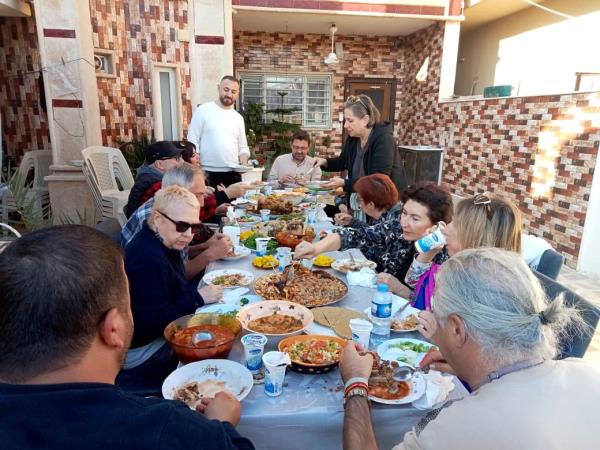
A picnic is set out under the trees. On the table: bottles of lemonade, heaps of naan, plates of dolma and olives and fruit, a beyond massive pot of yoghurt. On the grass, a massive, sun-faded rug, and a shisha pipe. An old kettle set up on a stove nearby.
When Kurdish friends and family get together for a proper picnic, it’s an all-day affair, stretching over two mealtimes. There are barbecued meats, music and games. Spring – and particularly Nowruz, the new year celebrations– bring picnics aplenty. tours to Iraqi Kurdistan, which usually take place in the balmy weather of spring and autumn, are bound to include a picnic or two – after all, Kurdish food is something to be savoured, and, with mountains like these, who wouldn’t want to be outside in the fresh air?
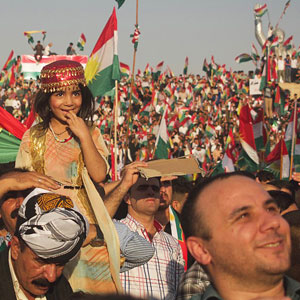
This isn’t a culture kept behind closed doors. Kurdistan wears its Kurdish pride out on its sleeve – quite literally, when you see people donning their traditional dress. Kurdish music blasts on car stereos and in shops, flags blaze along streets. If you want to hear a story, head to a bazaar or the teahouse in any town – everyone knows each other, and the cast of characters sprawls across the city. Join a Kurdish dance – done in a line, with simple steps – and you could be there for ages, locked in to the joy of it.
“The local people loved meeting us and interacting.” says traveller Tamara Michael who went on our Iraq Kurdistan holiday. It’s a society with hospitality at its core; you’ll find yourself warmly welcomed, plied with sweet tea, and having to fend off freebies. People are curious of visitors, and often keen to welcome you.
A picnic is set out under the trees. On the table: bottles of lemonade, heaps of naan, plates of dolma and olives and fruit, a beyond massive pot of yoghurt. On the grass, a massive, sun-faded rug, and a shisha pipe. An old kettle set up on a stove nearby.
When Kurdish friends and family get together for a proper picnic, it’s an all-day affair, stretching over two mealtimes. There are barbecued meats, music and games. Spring – and particularly Nowruz, the new year celebrations– bring picnics aplenty. tours to Iraqi Kurdistan, which usually take place in the balmy weather of spring and autumn, are bound to include a picnic or two – after all, Kurdish food is something to be savoured, and, with mountains like these, who wouldn’t want to be outside in the fresh air?
This isn’t a culture kept behind closed doors. Kurdistan wears its Kurdish pride out on its sleeve – quite literally, when you see people donning their traditional dress. Kurdish music blasts on car stereos and in shops, flags blaze along streets. If you want to hear a story, head to a bazaar or the teahouse in any town – everyone knows each other, and the cast of characters sprawls across the city. Join a Kurdish dance – done in a line, with simple steps – and you could be there for ages, locked in to the joy of it.
“The local people loved meeting us and interacting.” says traveller Tamara Michael who went on our Iraq Kurdistan holiday. It’s a society with hospitality at its core; you’ll find yourself warmly welcomed, plied with sweet tea, and having to fend off freebies. People are curious of visitors, and often keen to welcome you.


No friend but the mountains,” is a common Kurdish saying.![]()

Where is Kurdistan?
Kurdistan is a region spread across parts of Iran, Iraq, Syria and Turkey. Much of the area is mountainous – between the Zagros and Taurus Mountains. Kurdish people have inhabited the area for 4,000 years. Our trips tend to visit Iraqi Kurdistan, just part of the wider area.
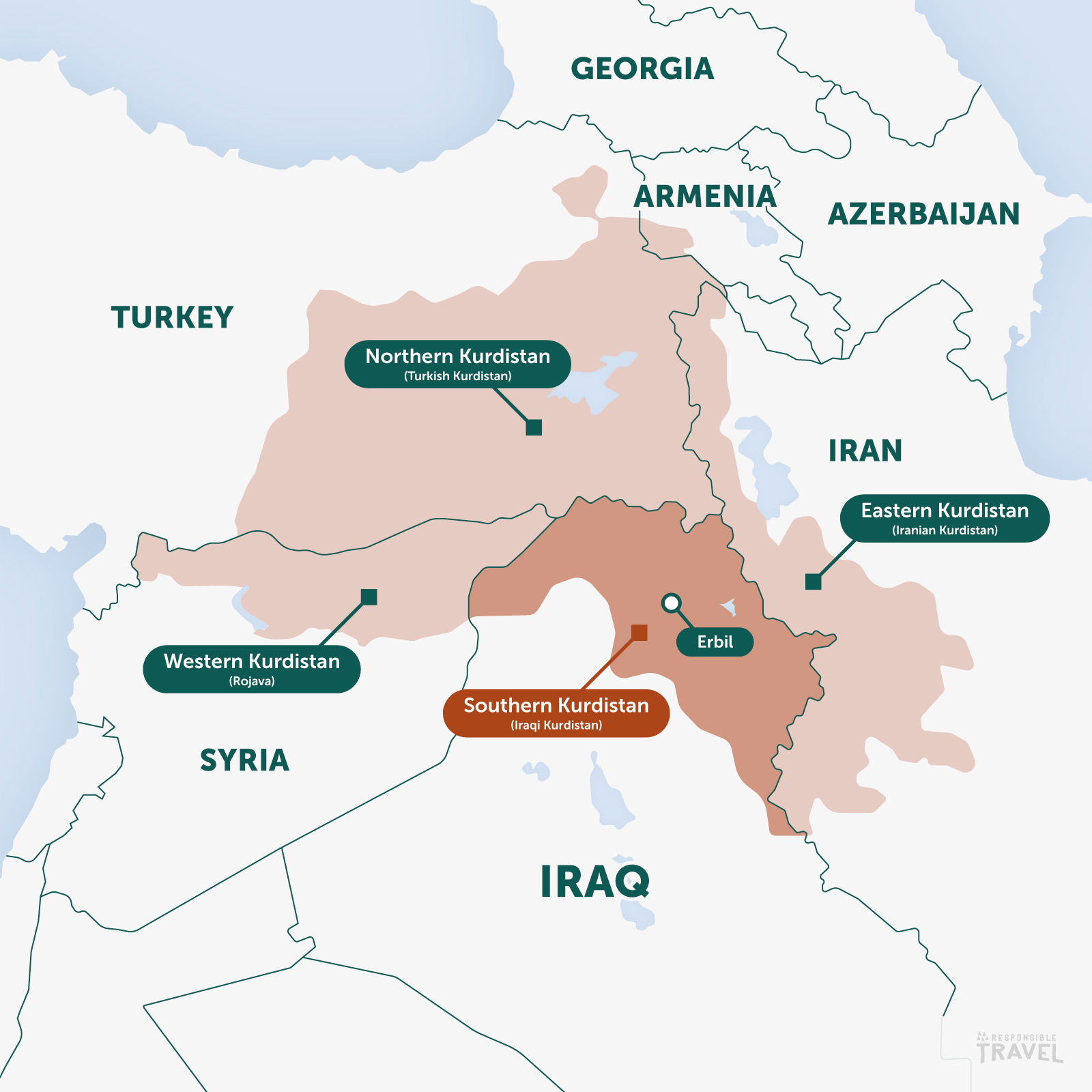
Iraqi Kurdistan, which became a federal region in 2005, has its own regional government and some five million of the world’s estimated 30-45 million Kurds: famously, this is the largest nation of people without a state, and it has a long, embattled history. In Iraqi Kurdistan, Iraqi-Kurdish conflict ran through the 20th century but escalated in the Iran-Iraq war. In 1988, Saddam Hussein’s regime started the Anfal campaign – an attempt to eliminate the Kurdish people. Human Rights Watch described it as a genocide. “No friend but the mountains,” is a common Kurdish saying.
Iraqi Kurdistan is sometimes known as ‘the other Iraq’ but for years, visiting Iraq has generally meant visiting here, no ‘other’ about it. Despite a long history of oppression and brutality directed against it, this scenic mountain area is safe and welcoming. You can visit Iraqi Kurdistan as part of a wider tour of Iraq, too.
On a classic itinerary of the region itself, the pendulum swings between beauty and horror – ancient wonders; a beautiful mountain topped with the ruined palace of a brutal dictator; a thriving cultural city where the main attraction is the building where prisoners were tortured and killed.
Anyone with even a passing interest will be blown away by the amount of history here.![]()
Arriving early on the scene
A 3,500-year-old clay tablet in the Slemani Museum contains a section of the world’s oldest epic poem, the Epic of Gilgamesh.
Tourists are relatively rare in Iraqi Kurdistan – but being one of few visitors has its benefits. The director of the Slemani Museum gives tours a personal introduction to the archaeological collection.
Yet, whilst there are treasures dating back thousands of years, there are also the inevitable stories of lootings, and the various ways in which the nation’s heritage has been sold off. Tablet V of the Epic of Gilgamesh was stolen during the Gulf War and only returned from America to Iraq in 2021.
Anyone with even a passing interest will be blown away by the amount of history here – 75,000-year-old Neanderthal remains have been found in Shanidar Cave near Barzan in northern Kurdistan. One of the oldest Christian monasteries to exist is a couple of hours’ drive down the road.
The history is fragile. There have been centuries of looting and the lack of preservation in successive wars and conflict and then flagrant rebuilding – Saddam Hussein built into the ancient citadel of Erbil – the oldest continuously used settlement in the world – his gate has since been dismantled.
Tourists are relatively rare in Iraqi Kurdistan – but being one of few visitors has its benefits. The director of the Slemani Museum gives tours a personal introduction to the archaeological collection.
Yet, whilst there are treasures dating back thousands of years, there are also the inevitable stories of lootings, and the various ways in which the nation’s heritage has been sold off. Tablet V of the Epic of Gilgamesh was stolen during the Gulf War and only returned from America to Iraq in 2021.
Anyone with even a passing interest will be blown away by the amount of history here – 75,000-year-old Neanderthal remains have been found in Shanidar Cave near Barzan in northern Kurdistan. One of the oldest Christian monasteries to exist is a couple of hours’ drive down the road.
The history is fragile. There have been centuries of looting and the lack of preservation in successive wars and conflict and then flagrant rebuilding – Saddam Hussein built into the ancient citadel of Erbil – the oldest continuously used settlement in the world – his gate has since been dismantled.
Rebuilding the region
The faces of the Kurdistan’s mountain valleys were changed under Saddam Hussein’s regime: villages were razed, forests eliminated to rout the Peshmerga – the Kurdish military, who fought against the regime. Traditional craft practices were hollowed out. The Kurdish government have been restoring buildings, planting trees and working to preserve historical artefacts.
Kurdistan is keen for more tourists. In 2025, Visit Kurdistan, a tourism initiative which has government backing, was launched. Its goal is to attract 20 million tourists by 2030.
Destination management companies work hand in hand with the government on guiding their tourism policies. “We have been at the forefront of encouraging sustainable tourism for many years,” says a destination manager for our partner Undiscovered Destinations. “Part of this is encouraging the government to adopt appropriate policies.”
Ancient sites are a priority. In the 2020s, a tourist sparked outrage by spray painting in Bahiri Cave – raising questions about how sites were being protected. “The restoration and preservation of sites is critical to the promotion of tourism in the region,” says our partner. “We have generally encouraged site protection as an important element: such as the prevention of graffiti and desecration of sites such as Zarzi Cave, plus many others.” The Kurdistan regional government has since launched a tourism police force.
Currently, much of the region’s wealth comes from oil. This money is not evenly distributed; many Kurdish people have made life threatening journeys to other countries to seek work. It can feel troubling to visit a place that so many have left; you may meet people who have relatives who live near you, who are sending money home here.
“Iraq is not as developed as many neighbouring countries. If guests come expecting everything to work smoothly, they will be disappointed – and that can disrupt tours,” says our partner. “The main thing is to be patient and respectful. Be mindful of the culture and current stage of development of tourism.” Our trips may often include a homestay, too, so you can really experience Kurdish hospitality.
Kurdistan is keen for more tourists. In 2025, Visit Kurdistan, a tourism initiative which has government backing, was launched. Its goal is to attract 20 million tourists by 2030.
Destination management companies work hand in hand with the government on guiding their tourism policies. “We have been at the forefront of encouraging sustainable tourism for many years,” says a destination manager for our partner Undiscovered Destinations. “Part of this is encouraging the government to adopt appropriate policies.”
Ancient sites are a priority. In the 2020s, a tourist sparked outrage by spray painting in Bahiri Cave – raising questions about how sites were being protected. “The restoration and preservation of sites is critical to the promotion of tourism in the region,” says our partner. “We have generally encouraged site protection as an important element: such as the prevention of graffiti and desecration of sites such as Zarzi Cave, plus many others.” The Kurdistan regional government has since launched a tourism police force.
Currently, much of the region’s wealth comes from oil. This money is not evenly distributed; many Kurdish people have made life threatening journeys to other countries to seek work. It can feel troubling to visit a place that so many have left; you may meet people who have relatives who live near you, who are sending money home here.
“Iraq is not as developed as many neighbouring countries. If guests come expecting everything to work smoothly, they will be disappointed – and that can disrupt tours,” says our partner. “The main thing is to be patient and respectful. Be mindful of the culture and current stage of development of tourism.” Our trips may often include a homestay, too, so you can really experience Kurdish hospitality.
Best time to go on a tour of Iraqi Kurdistan
Join one of our small group tours to get around with ease – most run in the spring and autumn: April or October. Avoid May to September. In the summer, temperatures rise. Maximum daily highs go over 40°C in July and August, and remain in the high 30s through September.
Iraq history tour, Mesopotamia Explorer
Discover ancient Mesopotamia where civilisations first began
From
£3999 to £4199
10 days
ex flights
Iraq tailor made holiday
7 day journey exploring Baghdad, Babylon & Karbala
From
€1895 to €2015
7 days
ex flights
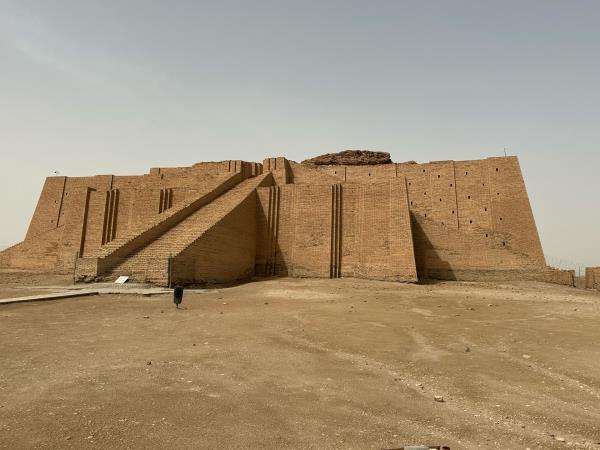
Iraq history tour, from Babylon to Kurdistan
A journey through the cradle of civilisation
From
£5999 to £6199
16 days
ex flights
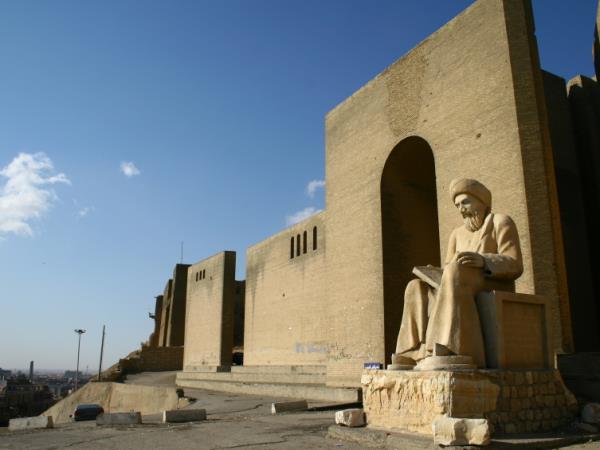
Iraq Kurdistan holiday
Iraqi Kurdistan is a fascinating place of sheer beauty
From
£2845
8 days
ex flights
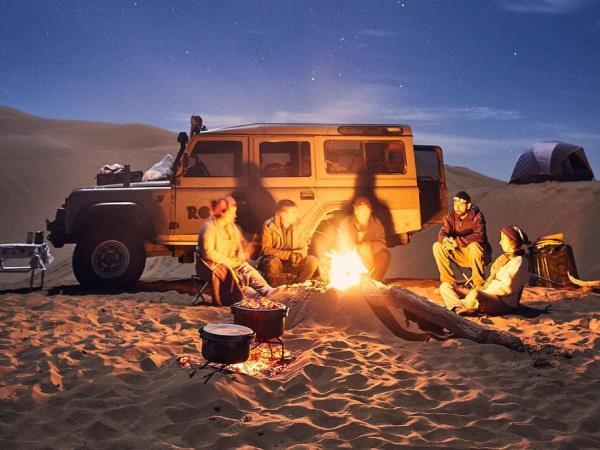
Iran and Iraq small group tour
Travel two lands shaped by thousands of years of history
From
€3440
15 days
ex flights
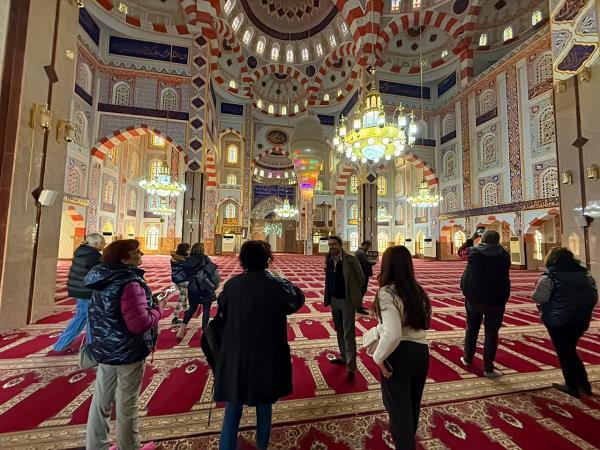
Iraq small group tour, 7 days
Engage with Iraq's living culture and resilient communities
From
€1895
7 days
ex flights


Contact Us
Call us for a chat about our holidays. We are happy to discuss your holiday and help in any way we can. No bots, queues or awful hold music.

01273 823 700
Call us after 10am
Calling from outside the UK

Where to go on Iraqi Kurdistan tours
You’ll travel from sites just 17km from the Turkish border (Amadiya) to cities 13km from Iran (Halabja) when touring this region.
First, aim for the bullseye: even today, Erbil’s concentric-road layout centres around a raised mound that is one of the oldest settlements anywhere in the world. This is the region’s capital and the place most tours begin. If its citadel, the only UNESCO-listed site in Iraqi Kurdistan, isn’t enough of a historic start, you’re not far from Gaugamela. The battle of Gaugamela was one of the most important battles of the ancient world. Alexander the Great had a decisive victory over the Persians, despite being heavily outnumbered. The location of the battlefield isn’t pinpointed, but the story is vivid enough to bring the surrounding fields to life.
You might use the Hamilton Road to leave Erbil – this road, which opened up some of the most scenic areas of the region, was named after the new Zealander chief engineer who built it. It was completed in 1932.
You might use the Hamilton Road to leave Erbil – this road, which opened up some of the most scenic areas of the region, was named after the new Zealander chief engineer who built it. It was completed in 1932.
Don thick socks, and don’t wear blue: that’s the advice for visiting Lalish, 120km northwest of Erbil, a pilgrimage site for Yezidi pilgrims – the Yezidi are considered some of the earliest inhabitants of the region. Just a couple of dozen followers of this very small sect live in this tiny village. Local guides here will explain the complex customs before you visit – including the fact you’ll need to be prepared to take your shoes off.
Continue northwest to Dohuk – a base from which you can visit the churches and monasteries of Al Qush, where a monastery – and one of the earliest Christian sites – is built on a rock in the mountains, surrounded by caves in which the devout lived as hermits. Next, in a disorientating about-turn, you can visit the remains of one of Saddam’s summer palaces in Gara, sitting on top of a mountain, now stripped of its tiles and marble (there’s still a beautiful view from his former bedroom).
Go further into the mountains to reach Amadiya, a settlement entirely self-contained on a mesa in the Great Zab river valley. It’s so well defended that an arched stone gate, reached up crumbling stone steps on the side of the rock, was once the only way in.
Continue northwest to Dohuk – a base from which you can visit the churches and monasteries of Al Qush, where a monastery – and one of the earliest Christian sites – is built on a rock in the mountains, surrounded by caves in which the devout lived as hermits. Next, in a disorientating about-turn, you can visit the remains of one of Saddam’s summer palaces in Gara, sitting on top of a mountain, now stripped of its tiles and marble (there’s still a beautiful view from his former bedroom).
Go further into the mountains to reach Amadiya, a settlement entirely self-contained on a mesa in the Great Zab river valley. It’s so well defended that an arched stone gate, reached up crumbling stone steps on the side of the rock, was once the only way in.
Continuing east, you can head through the scenic Barzan region towards Rawanduz: you’re in the Zagros mountains now: there are mazes of gorgeous gorges and canyons, waterfalls like the oft-visted Bekal waterfalls and hiking routes – and lots of picnic spots.
Sulaymaniyah is considered Kurdistan’s cultural capital, and a relaxed city, despite the fact that the notorious Amna Suraka (Red Security buildings) are here. This is where Kurdish people were imprisoned and tortured under Saddam’s region. It is now a museum.
An essential stop, just under two hours further east from the city is Halabja at the far east of the region close to the Iranian border: it was here that the largest chemical attack on civilians outside of World War I occurred – when 5,000 people were killed by a gas attack by Ali Hassan al-Majid, an official in Saddam’s regime, in 1988. Photographs in the memorial museum show the dead lying in the street. You may meet and speak with people who have personal accounts of how the attacks affected their families.
Driving back to Erbil to finish your tour, you might stop at Zarzi Cave: 18,000 years ago, hunter gatherers sheltered here, sustained by a beautiful valley in which the Chemi Razan River runs. This is region where you’ll find history and horror, yes, but plenty of beauty and humanity, too.
Sulaymaniyah is considered Kurdistan’s cultural capital, and a relaxed city, despite the fact that the notorious Amna Suraka (Red Security buildings) are here. This is where Kurdish people were imprisoned and tortured under Saddam’s region. It is now a museum.
An essential stop, just under two hours further east from the city is Halabja at the far east of the region close to the Iranian border: it was here that the largest chemical attack on civilians outside of World War I occurred – when 5,000 people were killed by a gas attack by Ali Hassan al-Majid, an official in Saddam’s regime, in 1988. Photographs in the memorial museum show the dead lying in the street. You may meet and speak with people who have personal accounts of how the attacks affected their families.
Driving back to Erbil to finish your tour, you might stop at Zarzi Cave: 18,000 years ago, hunter gatherers sheltered here, sustained by a beautiful valley in which the Chemi Razan River runs. This is region where you’ll find history and horror, yes, but plenty of beauty and humanity, too.
More Iraq articles
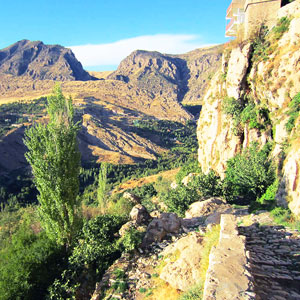
Iraq’s sweltering summer season brings temperatures in excess of 40°C, so it’s best to stick to the spring and autumn.
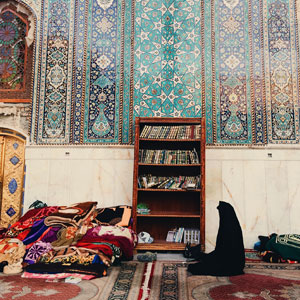
Meet welcoming people and discover citadels, bazaars, and monasteries when you head north to Iraqi Kurdistan.
Iraq should be a big draw for adventurous travellers, thanks to its beautiful landscapes and its ancient cities and monuments.