



Is it okay to swim with dolphins in the wild?

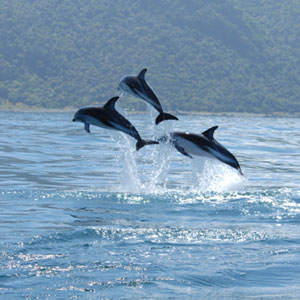
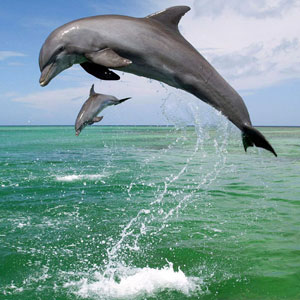
There is a pod of bottlenose dolphins resident off the Sussex coast, where Responsible Travel is based. I’ll never forget sitting on Brighton beach a few years ago, waiting for a summer sunset, and watching as a dolphin leapt clear out of the water right in front of me. Their playfulness and the way they seem to delight in movement is intoxicating. It’s no surprise that so many people love the thought of swimming with dolphins.

I’ve swum with dolphins twice. In Kaikoura, on the South Island of New Zealand some 20 years ago, and then again in the Azores in 2023, when I was accompanied by my son. In Kaikoura, I was lucky enough to find myself surrounded by a pod of dozens of curious dolphins, while in the Azores we could just about make out one very disinterested dolphin far off in the distance.

But the two experiences were also different in another way. In Kaikoura, around 20 of us were encouraged into the sea at the same time, whereas in the Azores it was limited to just two people. And while there’s still a very long way to go towards the ethical treatment of wild dolphins in tourism, I hope this is an indication of the progress that’s been made towards responsible dolphin swimming over the years.

Is swimming with dolphins ethical?

First, to be clear, we’re talking about swimming with wild dolphins in the sea. Aquariums and marine parks might dress it up as educational or ‘spiritual’, but swimming with captive dolphins is never ethical.

There is only one way to swim with dolphins ethically, and that is in their natural environment, with the dolphins free to behave entirely naturally.

However, a natural setting does not by itself mean you’re enjoying an ethical experience. The activity needs to be run responsibly, which is to say in line with official guidelines. There are no universal rules around swimming with dolphins; instead every country or territory will tend to create its own. But there are two golden rules:

Dolphin well-being always trumps tourists’ enjoyment Swimmers need to be safe in the water
Amanda Stafford is the founder of our partner The Dolphin and Whale Connection: “Something I’ve always tried to instil in people is the importance of calmness. When you’re calm, they are, and when they’re comfortable they come so close it’s extraordinary.”

How to swim ethically with dolphins

The second time that I swum with dolphins was in the Azores, a Portuguese archipelago that after centuries of whale-hunting has entirely reversed course to become a world leader in ethical marine wildlife tourism.

During our excursion there was only our RIB (Rigid Inflatable Boat) with about 10 passengers on board, and a marine biologist guide. On sighting a pod of dolphins, the boat slowed to a crawl, then once we were in position – with the dolphins swimming towards us – the driver cut the engines altogether to ensure there was no risk of dolphins (or swimmers) being hurt by a moving propeller.

We had already been briefed on how to behave before departure, and everyone had had to sign a disclaimer that they were experienced at swimming in open water. Two people at a time were allowed to slip carefully into the water (no jumping) and were directed where to go. They would snorkel among the dolphins for five minutes before coming back aboard, and only when they were in their seats would another two people be allowed in.

After about 15 minutes it was clear the dolphins weren’t interested in us and rather than pressing on with the activity, potentially distressing them, it was rescheduled and the boat left the area. It had been made clear before we set off that this was a possibility. Overall, the experience felt as if it was managed responsibly.

A more ethical dolphin-swimming experience

Swimmers need to be confident in open water, wearing buoyancy aids, and given a safety briefing before departure. Dolphins are wild animals. Their behaviour can be unpredictable, and potentially aggressive. Curiosity does not always equal friendliness. Boats should slow their speed when approaching marine life, and engines should be put in neutral whenever it is known that animals are within 50m, or when there are swimmers in the water. Boats should never intentionally divide or block a pod of dolphins. Swimmers should not get in the water when dolphins are clearly feeding or at rest. Interacting with them during such times can disrupt natural behaviours, lead to dolphins becoming exhausted, and can encourage them to permanently leave an area.
The problem is when you have a pod of dolphins resting or feeding, and a boat crashes through disturbing them. I mean, how would you feel if a tour bus drove through your living room?
– Amanda Stafford, founder of our partner The Dolphin and Whale Connection
Swimmers shouldn’t be in the water with the dolphins for longer than 20 minutes. Prolonged interaction with humans reduces dolphins’ natural fear of people, and can lead to boat strikes, dolphins becoming entangled in fishing gear, or the animals being intentionally harassed by people. Swimmers should let the dolphins approach them, and not attempt to touch or feed them. Physical contact, whether intentional or accidental, can lead to injury or the spread of disease. Apart from buoyancy aids and cameras (not mounted on selfie sticks), nothing should be taken into the water.

Contact Us

Responsible Travel, Travel Team

Call us for a chat about our holidays. We are happy to discuss your holiday and help in any way we can. No bots, queues or awful hold music.


Responsible Travel, Travel Team

Should swimming with dolphins be banned?

We believe that swimming with dolphins can be done responsibly, and that by bringing people closer to the natural world, swimming with dolphins and similar forms of wildlife tourism can encourage a passion for conservation. We also note that many responsible tour operators donate parts of their profits to, or otherwise support, marine conservation and research initiatives.

Nevertheless, some organisations believe that the risks of dolphin-swimming outweigh the benefits, and that it should be banned outright. There have been concerns for a long time that some tour operators are behaving irresponsibly, allowing too many people in the water at a time and generally putting the enjoyment of their guests ahead of the animals’ interests. Research continues into whether swimming with cetaceans negatively affects their well-being.

Ensuring that swimming with dolphins is truly safe and ethical is much less easy, and much less profitable, than simply admiring the animals from a boat. So, in future, as regulations become tighter in many parts of the world, we think you’re likely to see fewer dolphin-swimming experiences. And because of that, when you do find these experiences being offered, it should be much easier to tell who is doing it responsibly, and who is not.
Written by Rob Perkins
Photo credits: [Page banner: Unsplash+] [Intro: Unsplash+] [A more ethical dolphin-swimming experience: Rudney Uezu]