

What wildlife will I see in Borneo?

Orangutans

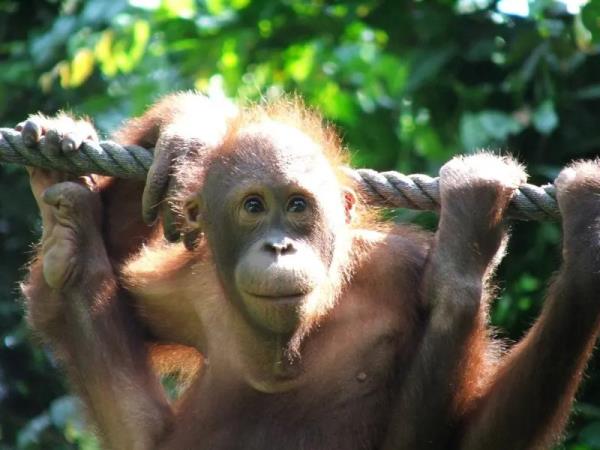
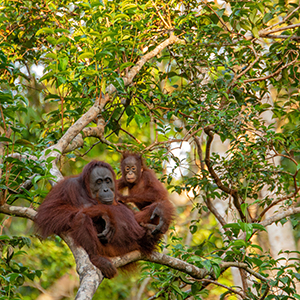
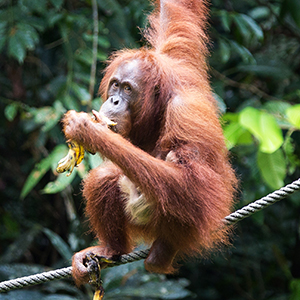
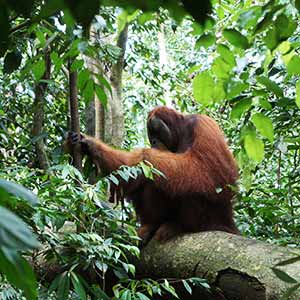
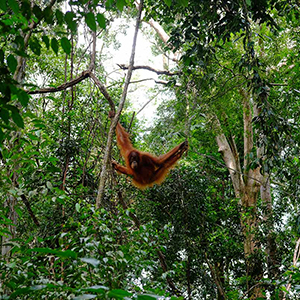
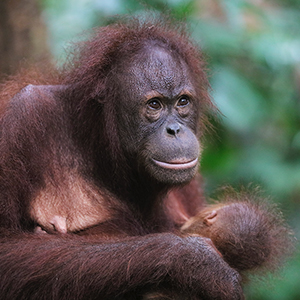
These strange creatures are quite unique – they are the only great ape to live outside Africa, and the only one which does not live in a group. They are also uniquely adapted to their forest habitat, spending far more time in the trees than their African cousins – chimpanzees, bonobos and gorillas – building nests to sleep in and swinging through the treetops with their great, long arms. Orangutans are renowned for their intelligence; some groups have been discovered using tools, and they have been observed using leaves to make rain hats and as waterproof covers for their nests. Experiments in the 1960s also found they were able to learn basic sign language – putting them on an intellectual par with chimps.

Baby orangutans are much like baby humans; they spend seven or eight years by their mothers’ sides, learning to climb, swing, forage and build nests. Orphans who arrive at the rehabilitation centres are paired with adults through a buddy system, as their human carers cannot teach them all they need to know about being a wild orangutan! Orangutans eat fruit, bark, honey, leaves and insects – but one of their favourite treats is the foul-smelling durian fruit.
Said to have the rising sun on their chests, Southeast Asia's sun bear is the world's smallest bear, and one of its most mysterious.

Sun bears

Sun bears live in remote forest areas, emerging at night to feast on fruits, insects and even small rodents and reptiles. Their long tongue helps them suck honey straight from bees’ nests. Their gentle nature means there is a demand for the babies as illegal pets – hastening their disappearance from the forests. The world’s only sun bear sanctuary is in Sepilok – so go and visit them, and contribute to their conservation.

Proboscis monkeys

Found only in Borneo, proboscis monkeys are regularly lauded as one of the world’s ugliest creatures. The reason for the males’ pendulous noses is not fully understood, though it could help their honking calls resonate through the forests, or be used to seduce females. The males have the longest noses of all primates – 10cm is common, though older monkeys can have noses stretching up to 17cm.

This is one of the largest monkey species, and one of their most surprising characteristics is perhaps how human they are, as they lounge in the trees with their legs dangling from the branches.

Sadly, as a result of severe habitat loss, these amusing monkeys are now listed as endangered, although several are sheltered within Borneo’s orangutan sanctuaries. And luckily for them, the Ugly Animal Preservation Society is on their side.

Our top trip

Borneo tour, Great Apes and Beach escapes

Borneo tour, Great Apes and Beach escapes

Borneo's best cities, lush rainforests & paradise beaches

From £2599 9 days ex flights
Tailor made:
Everything is tweak-able, giving you the freedom to build your own unique and meaningful trip. Slow down the pace with few extra nights here and there, add a few more active adventures along the way, upgrade your accommodation for that extra bit of luxury – it’s up to you!

Contact Us

Responsible Travel, Travel Team

Call us for a chat about our holidays. We are happy to discuss your holiday and help in any way we can. No bots, queues or awful hold music.


Responsible Travel, Travel Team
The adorable, big-eyed slow loris has grown in popularity as an exotic pet in recent years, thanks to seemingly cute YouTube videos.

Slow lorises

The reality is that these sweet-faced primates deliver a sharp, venomous bite. Worse, the demand for them has encouraged poachers to capture them in the forests, and pull out their teeth. There is only one way to truly enjoy the endangered slow loris: in the wild. Take a thrilling nighttime jungle trek with an experienced guide, and glimpse their huge eyes shining in the foliage.
Written by Vicki Brown
Photo credits: [Page banner: Jefri Tarigan] [Orangutans: nomads.team] [Sun bears: Siew Te Wong, Thye Lim Tee, and Lin May Chiew, BSBCC] [Proboscis monkeys: pen_ash] [Slow lorises: Jmiksanek]