Sail & ski in Norway
Combining sailing and skiing? Yes, you heard that right – Norway’s fjord and mountain landscape is ideally suited for this unique activity.
Imagine anchoring a 50ft sailing boat at the foot of a mountain, climbing into a tender clutching a pair of skis and being taken to the shore to change into your ski gear on the beach. In your rucksack: a foodpack designed to get you through a 5,000-calorie activity and 2,000m of elevation gain. Plus, avalanche gear: beacon, probe and spade.
You and your shipmates are going ski touring. You’ll climb up into the mountains that rise straight out of the sea on skis fitted with skins. You’ll celebrate reaching the top with a nice rest, then, you peel the skins away for an exhilarating ski back down to the boat – which you might even still be able to see, anchored far below. This is sailing and skiing, a holiday you can try in destinations like the Lofoten Islands, the Lyngen Alps, and in the far northern Svalbard archipelago.
Imagine anchoring a 50ft sailing boat at the foot of a mountain, climbing into a tender clutching a pair of skis and being taken to the shore to change into your ski gear on the beach. In your rucksack: a foodpack designed to get you through a 5,000-calorie activity and 2,000m of elevation gain. Plus, avalanche gear: beacon, probe and spade.
You and your shipmates are going ski touring. You’ll climb up into the mountains that rise straight out of the sea on skis fitted with skins. You’ll celebrate reaching the top with a nice rest, then, you peel the skins away for an exhilarating ski back down to the boat – which you might even still be able to see, anchored far below. This is sailing and skiing, a holiday you can try in destinations like the Lofoten Islands, the Lyngen Alps, and in the far northern Svalbard archipelago.


Our crew Peder and Alessandro made this an experience to remember! We settled right in on the comfy boat, enjoyed good laughs, skied so many great lines in really nice snow, saw fantastic scenery and made lots of memories![]()

– Traveller on our ski and sail holiday
The cradle of skiing: introducing Norway as a sail & ski destination
Norway is sometimes known as the cradle of skiing – with mountains like these, who wouldn’t want to strap on a pair? Yet the origins of sail and ski are a little different. The story goes that it was Italian and French holidaymakers visiting Norway who took the plunge first, renting a boat to sail to the foot of skiable mountains at the edge of fjords. It’s since caught on with Norwegians, and our partner Seil Norge have been running trips for over 15 years.
The Norwegian language has a near-untranslatable word for the freedom and beauty of skiing: skiglede – or “ski joy”. It doesn’t get much more beautiful than the Lofoten Islands, where alp-steep mountains covered with snow rise straight out of the water. Sail and ski gives you ultimate skiglede; the boat gives you the freedom to go where you like, so you can find the most beautiful of peaks, and the best snow.
In Lofoten you can often see the top of the mountain from the boat – and don’t have a long walk in before you can start your ascent. The guide can easily point out where you’re going, and you can have some fleeting second thoughts over your breakfast of brunost and bread, before putting them aside, packing your matpakke (foodpack – for your lunch) and piling into the tender to go ashore.
The Norwegian language has a near-untranslatable word for the freedom and beauty of skiing: skiglede – or “ski joy”. It doesn’t get much more beautiful than the Lofoten Islands, where alp-steep mountains covered with snow rise straight out of the water. Sail and ski gives you ultimate skiglede; the boat gives you the freedom to go where you like, so you can find the most beautiful of peaks, and the best snow.
In Lofoten you can often see the top of the mountain from the boat – and don’t have a long walk in before you can start your ascent. The guide can easily point out where you’re going, and you can have some fleeting second thoughts over your breakfast of brunost and bread, before putting them aside, packing your matpakke (foodpack – for your lunch) and piling into the tender to go ashore.
You have to be ready for a ski adventure because you never know what you will get.![]()
Skiing for your supper: what to expect from ski touring
Ski touring is hard work. You may spend a morning climbing up an 800m mountain – of course, you’re always starting at sea level – then less than half an hour skiing back down. The exercise is repeated in the afternoon. It’s a 5,000-calorie endeavour that will have you both skiglede, and grateful to be alive.
In the afternoon, after a warming soup back on the boat, you’ll sail to a new destination for the evening. In Lofoten this might be just around the headland. In other locations, ski destinations can be a little more spread out.
You don’t need to know how to sail – it’s the means to an end – but you do need to know how to ski tour. For instance, you need to be able to do a kick turn when climbing up a slope. “We really like to teach people how to sail,” says Marie-Lou Blandin from our partner Seil Norge. “The skipper will always teach you how to put the sail, how to navigate. It’s a great trip to give you a taste of sailing. Usually, our clients are more into ski; the sailing is a plus. If it’s your first time coming on a sailing boat, that’s no problem.”
Coastal mountains experience less stable weather than mountains inland, and this can mean more variable snow quality and trickier conditions than, say, skiing in the Alps. “You’re always adapting to the weather in Lofoten,” says Marie-Lou. “It can change a lot. It’s more adventurous ski touring in Norway than France. You have to be ready for a ski adventure because you never know what you will get.”
In the afternoon, after a warming soup back on the boat, you’ll sail to a new destination for the evening. In Lofoten this might be just around the headland. In other locations, ski destinations can be a little more spread out.
You don’t need to know how to sail – it’s the means to an end – but you do need to know how to ski tour. For instance, you need to be able to do a kick turn when climbing up a slope. “We really like to teach people how to sail,” says Marie-Lou Blandin from our partner Seil Norge. “The skipper will always teach you how to put the sail, how to navigate. It’s a great trip to give you a taste of sailing. Usually, our clients are more into ski; the sailing is a plus. If it’s your first time coming on a sailing boat, that’s no problem.”
Coastal mountains experience less stable weather than mountains inland, and this can mean more variable snow quality and trickier conditions than, say, skiing in the Alps. “You’re always adapting to the weather in Lofoten,” says Marie-Lou. “It can change a lot. It’s more adventurous ski touring in Norway than France. You have to be ready for a ski adventure because you never know what you will get.”
Yes, there is such thing as ‘right side up’ snow – and many other types of snow besides![]()
Keeping safe – whilst retaining the joy
Experts are at the heart of these trips. “Our colleagues practise ski touring every winter. That’s why I moved to Norway,” says Marie-Lou, who is originally from France. “It’s what we do from February to May – and even into June.” They have worked with some of their guides for over 15 years and many are from the local area. Knowing how to identify the right type of snow (yes, there is such thing as ‘right side up’ snow – and many other types of snow besides), and seeing what the weather is doing, is crucial – as is the ability to read the group and know when to turn back.
Every morning you’ll convene to agree a plan for the day. “We work as a team to decide what we are going to do,” says Marie-Lou. “And the rule is never go to the top if the snow is not good enough. We always go back if we need to. Of course, we have people who want to reach the summit – it’s a goal – but we always have to be prepared to turn around and go and find another place to ski.” You’ll follow the instructor as they take the most efficient route up the mountain to conserve the group’s energy, and keep a steady pace up to ensure everyone is calm, safe and reaches the top.
Safety is everyone’s priority. On the first day you’ll have a refresher on avalanche training and other safety briefings (travelling with an experienced group with a great safety record means the chance of you actually being caught in an avalanche are incredibly low).
Every morning you’ll convene to agree a plan for the day. “We work as a team to decide what we are going to do,” says Marie-Lou. “And the rule is never go to the top if the snow is not good enough. We always go back if we need to. Of course, we have people who want to reach the summit – it’s a goal – but we always have to be prepared to turn around and go and find another place to ski.” You’ll follow the instructor as they take the most efficient route up the mountain to conserve the group’s energy, and keep a steady pace up to ensure everyone is calm, safe and reaches the top.
Safety is everyone’s priority. On the first day you’ll have a refresher on avalanche training and other safety briefings (travelling with an experienced group with a great safety record means the chance of you actually being caught in an avalanche are incredibly low).
High peaks reached the low-impact way
Sail and ski is low impact when done consciously. “We try and always use the sail as much as we can,” says Marie-Lou. “It’s really important to us and we have competition between different boats of who used the least benzene.” Local suppliers provide everything from food to saunas to ski hire.
Marie-Lou also has tips for getting to these northern locations in the first place. “You can come without flights. We can explain how to get there by boat, train and bus from Oslo.” You can even get to Svalbard flight-free on a sailing crossing from Tromso.
Marie-Lou also has tips for getting to these northern locations in the first place. “You can come without flights. We can explain how to get there by boat, train and bus from Oslo.” You can even get to Svalbard flight-free on a sailing crossing from Tromso.
Life on board: what to expect
Is it cold on the boat? You won’t be the first person to ask about the heating: “Guests are really scared!” says Marie-Lou “But our boats are really warm. We use heating all the time.”
The longer the trip, the more chances you have for good weather and snow, and more opportunities to ski. If the group get tired, you may have a half day off to rest, sail and fish off the boat (fishing season in Lofoten is also in the winter). Spend downtime interspersing local saunas with sea dips, or gathering around a bonfire on the beach.
Our partners often run two boats together in Lofoten, so there can be two ski groups to suit different ability levels. You can spend time socialising between boats in the evenings. “We may not go in the same area for skiing,” says Marie-Lou, “But we may spend the night in the same harbour. We can have dinner, share the night, and have drinks. It’s a really good atmosphere.”
Between encouraging each other on the climb, celebrating a summit, following each other’s tracks down the mountain, or wet footprints down the jetty into the sea: there’s a lot of camaraderie on these trips. Not only do you ski together, but you’ll cook for each other; cabins rotate cooking duties.
You’ll meet a very interesting bunch of other travellers: split-boarders, passionate paragliders, and people who spend their summers hiking or mountain biking. People of all ages and nationalities do these trips. Their previous experiences will give you plenty of inspiration for your next adventure... though this one will be hard to top.
The longer the trip, the more chances you have for good weather and snow, and more opportunities to ski. If the group get tired, you may have a half day off to rest, sail and fish off the boat (fishing season in Lofoten is also in the winter). Spend downtime interspersing local saunas with sea dips, or gathering around a bonfire on the beach.
Our partners often run two boats together in Lofoten, so there can be two ski groups to suit different ability levels. You can spend time socialising between boats in the evenings. “We may not go in the same area for skiing,” says Marie-Lou, “But we may spend the night in the same harbour. We can have dinner, share the night, and have drinks. It’s a really good atmosphere.”
Between encouraging each other on the climb, celebrating a summit, following each other’s tracks down the mountain, or wet footprints down the jetty into the sea: there’s a lot of camaraderie on these trips. Not only do you ski together, but you’ll cook for each other; cabins rotate cooking duties.
You’ll meet a very interesting bunch of other travellers: split-boarders, passionate paragliders, and people who spend their summers hiking or mountain biking. People of all ages and nationalities do these trips. Their previous experiences will give you plenty of inspiration for your next adventure... though this one will be hard to top.
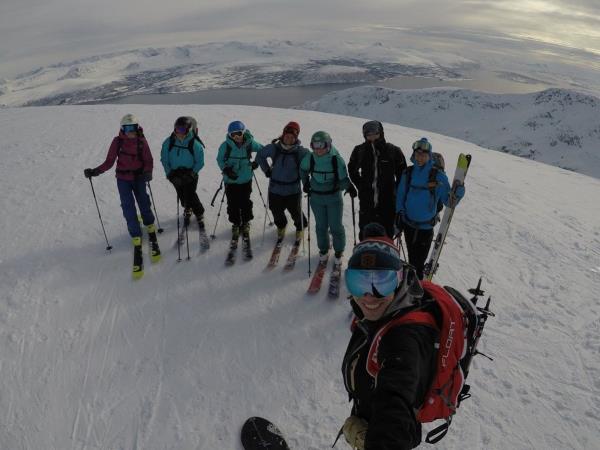
Svalbard sail & ski holiday
Wind-powered sailing meets epic ski touring in Svalbard
From
€2880
7 days
ex flights
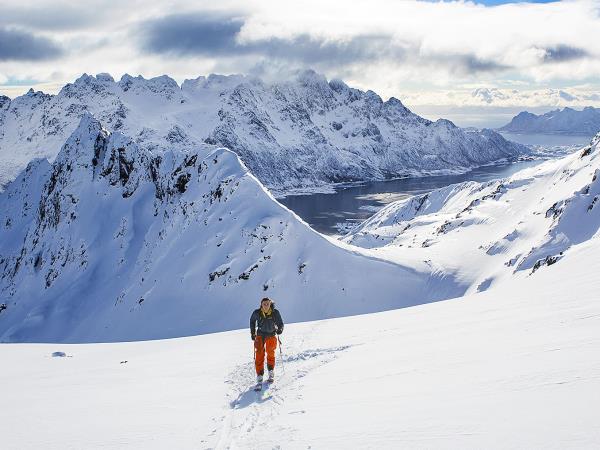
Skiing and sailing holiday in Norway
Easter sailing & trekking in the Lofoten and Lyngen Alpes
From
NKr41500
7 days
ex flights
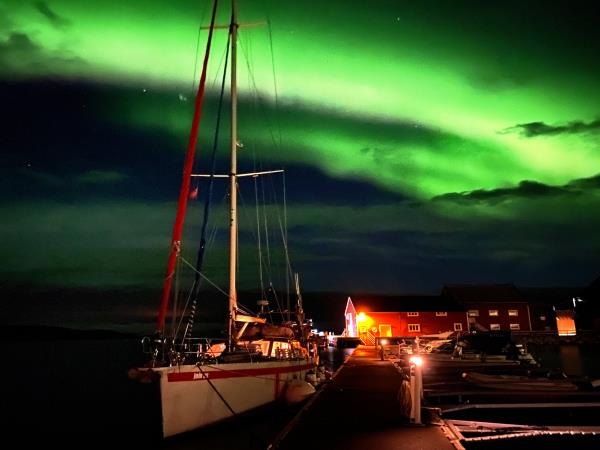
Norway sail & ski holiday
Sail Arctic fjords, ski wild peaks, spot whales
From
€1740
7 days
ex flights
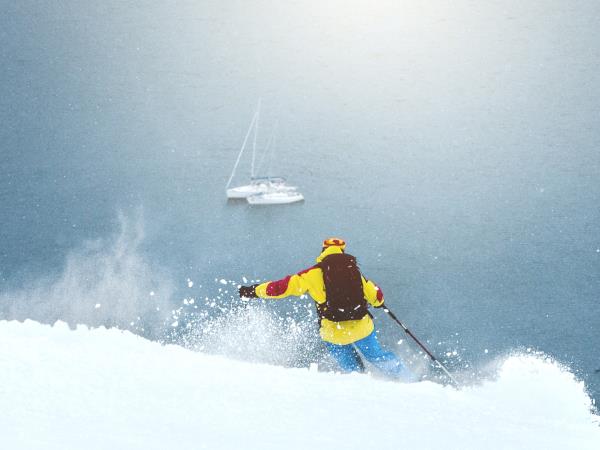
Ski and sail adventure in Norway
A unique ski adventure in the Lofoten fjords
From
NKr35500
5 days
ex flights


Contact Us
Call us for a chat about our holidays. We are happy to discuss your holiday and help in any way we can. No bots, queues or awful hold music.

01273 823 700
Call us until 4pm
Calling from outside the UK

FAQs on sailing & skiing holidays in Norway
Is it safe to go sailing & skiing?
Safety is everyone’s first priority on a holiday like this – because of the risk of avalanche, the risks of bad weather, and – in Svalbard – the risks posed by wildlife in the wilderness (which is why the ski guide will travel armed). Guides are vigilant with safety drills and daily briefing, and will never take risks. You’ll be travelling with experienced guides and experienced sailors, and people who know the area because they live there.
How fit do I need to be?
Expect five to eight hours of ski touring a day over a five to ten day trip, sailing each evening to get to the next destination. Ski touring involves climbing on skis up to 800m or 1000m, skiing down, and then repeating this in the afternoon so you may end up climbing as much as 2,000m a day. The guide will set a sensible pace for the group, and no one is getting left behind.
How experienced do I need to be?
You need to know how to ski tour – but you don’t need to know how to sail. If you’re a beginner to off-piste skiing, we can advise the best trip to join.
Do I need to bring my own skis?
Your own tried and tested equipment is best – boots you know fit, skis with free-heel bindings you know how to put on and take off. The local team will point you towards local hire shops if you need to rent additional equipment.
Where to go ski & sail in Norway?
Try the Lofoten Islands for easy-to-access peaks that you can ski early in the spring, or head to Tromso and the Lyngen Alps further north. Finnmark, the most northerly mainland region, has drier snow in the east, and glacier-cooled slopes. The Svalbard Archipelago is a five-day sail from Tromso for the brave, or a flight away. You’ll find true wilderness on Spitsbergen, and guides must travel armed in case of polar bears. Expect longer passages of sailing by boat, and a longer trip of ten days to get the most out of the island.
Best time to go skiing & sailing in Norway?
Go from February to May. Ski and sail holidays move with the light. Early in the year stay south (though still north of the Arctic Circle). As the days get longer you can move further north. The season starts in February-March (where there might be a welcome ‘March metre’ of snow in Lofoten) and ends in May, which is the best time to be in Svalbard.