Chennai to Kochi cycling holiday

Ever seen peppercorns growing in rich clusters on a tree? Or tea plantations so green that grass pales in comparison? In Munnar, Kerala, even the air smells of freshly-picked tea leaves![]()

Cyclists like to know where their next meal is coming from. But when you’re cycling from Chennai to Kochi, you only need to look around: at the cardamom estates, the tea plantations, the trucks loaded with sugar cane passing under coconut palms. And the rice paddies – so many rice paddies.
“It’s all rice,” says Sabir Mallick, of our specialist partner, Cycling in India. “Everything is made of rice. It’s not that we don’t get bread, but the eating habit is mostly rice or things made of rice.”
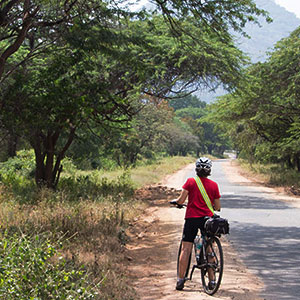
Cycling along the Kaveri River delta, among the green paddies and sugarcane plantations, you’ll see where he’s coming from. Cycling in southern India means tropical journeys in a land that’s fertile and fruitful. Get pedalling to generate a cooling breeze, and admire the cultivated landscapes, where rice, tea, fruit and spices are grown in abundance.
“It’s all rice,” says Sabir Mallick, of our specialist partner, Cycling in India. “Everything is made of rice. It’s not that we don’t get bread, but the eating habit is mostly rice or things made of rice.”
Cycling along the Kaveri River delta, among the green paddies and sugarcane plantations, you’ll see where he’s coming from. Cycling in southern India means tropical journeys in a land that’s fertile and fruitful. Get pedalling to generate a cooling breeze, and admire the cultivated landscapes, where rice, tea, fruit and spices are grown in abundance.

Why cycle across southern India?
There are two sides to the southern tip of India – there’s the state of Tamil Nadu, dominating the east, and then there’s Kerala state, roughly a third of Tamil Nadu's size, running along the west. Divided by the Western Ghats, the states speak different languages, but make great companion pieces to each other on a bike tour of southern India.The state capitals – Chennai in Tamil Nadu, and Kochi in Kerala – are roughly 700km apart, a one-hour flight. The same distance can be enjoyed over a 16-day coast to coast cycle, with nine days in the saddle, and plenty of stops – not just to rest, but to explore. Given the environmental cost of that one hour flight, cycling – even with a support bus – seems a virtuous solution. Just remember that when you’re pedalling over the Ghats.
“Tamil Nadu is absolutely flat cycling,” says Sabir, “It’s green everywhere because of the plantations, paddy fields and coconut trees everywhere. Cycling distances are long but it’s easy because its flat terrain.” The Western Ghats – a hilly blip – are followed by more level cycling on Kerala’s coast, and then a flop on the beach.
Chennai to Kochi cycling highlights
You stare into the misty tea leaves – but you’re not at a fortune teller’s house, but in a Keralan hill station, where low cloud among the bushes makes for atmospheric cycling.![]()
With two great coastlines, any cycling route worth its salt won’t just go straight across southern India; there's no fun in that. instead, you'll follow the east coast of India, through fishing villages and under the palm trees, down to Pondicherry and Karaikal.
Next, you'll venture inland, into Tamil's breadbasket – though rice basket would be more appropriate, given the vivid rice paddies you'll pass between Thanjavur and Chettinadu. Crossing the Western Ghats between Pulani and Munnar, you'll leave Tamil Nadu and enter Kerala. From here you make a beeline for the coast, to Marari in the Alappuzha district, where there's no more welcome sight than a nice flat, golden beach after a long day in the saddle.
Next, you'll venture inland, into Tamil's breadbasket – though rice basket would be more appropriate, given the vivid rice paddies you'll pass between Thanjavur and Chettinadu. Crossing the Western Ghats between Pulani and Munnar, you'll leave Tamil Nadu and enter Kerala. From here you make a beeline for the coast, to Marari in the Alappuzha district, where there's no more welcome sight than a nice flat, golden beach after a long day in the saddle.
Tea plantations
They're sometimes known as tea gardens, but this belies their massive scale: the neat tea bushes clumped, moss-like on the hill, make tea plantations a surreal landscape, stretching as far as the eye can see. This oft-mist shrouded area forms part of the hill region of the Western Ghats, the border between Tamil Nadu and Kerala. Centre yourself at Munnar, the hill station at the region’s heart; exploring by bike allows you to make short work of your undulating surroundings.Culture
“People are polite,” says Sabir, “And they give space to tourists.” For visitors who come to Tamil Nadu and Kerala, this might not be the first impression in some of the busier cities, but hospitality is extremely important to Tamil culture. Show respect in turn with a few words of Tamil, one of the world's oldest living languages. In its neighbouring state, religiously diverse Kerala has a reputation among tourists for its relaxed atmosphere, of which you can take full advantage at a beach resort.
Temples
There are temples aplenty to visit on a cycling trip through Tamil Nadu, but not all are created architecturally equal. The UNESCO-listed relief work that you see at the temple complex at Mahabalipuram shows fantastic craftmanship, plus, it’s right on the seafront. Then, visit Brihadeeswara Temple at Tanjore, which is notable for its enormous, carved granite tower. You’ll also visit many temples dedicated to Lord Murugan, Hindu God of War, known as the God of the Tamil people.
Beaches
It’s true that Pondicherry’s grid-like streets were better for cyclists back in the days when there was less motorised traffic – now, the city is a little more hectic. However, there’s much to be said for cycling down the Pondicherry seafront instead, between Paradise and Serenity beach. But Tamil Nadu’s Bay of Bengal beaches vie with Kerala’s Arabian Sea-facing sands, and it’s best to visit both to compare. Kerala might have the edge, as its coconut palm-fringed beaches face the sunset.
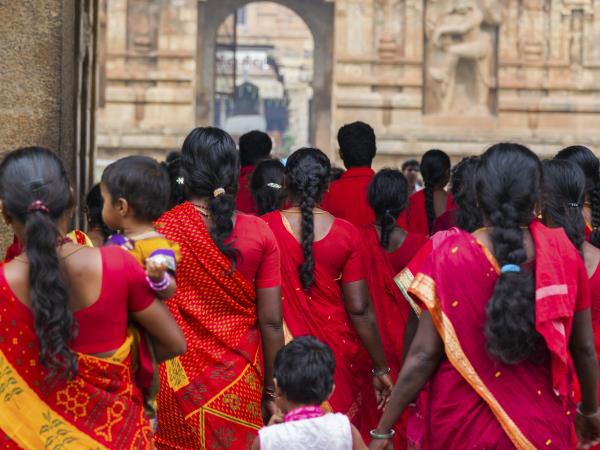
Chennai to Kochi cycling holiday, India
Coast to coast Southern India cycling tour
From
US $2560 to US $2930
16 days
ex flights
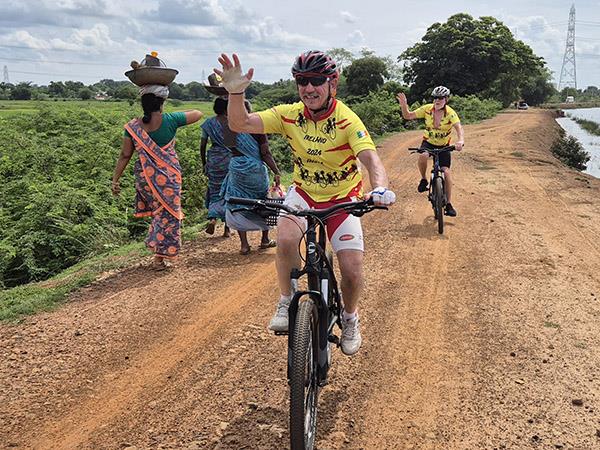
South India cycling tour, coast to coast
South India Coast to Coast cycling Holiday
From
US $2480
14 days
ex flights
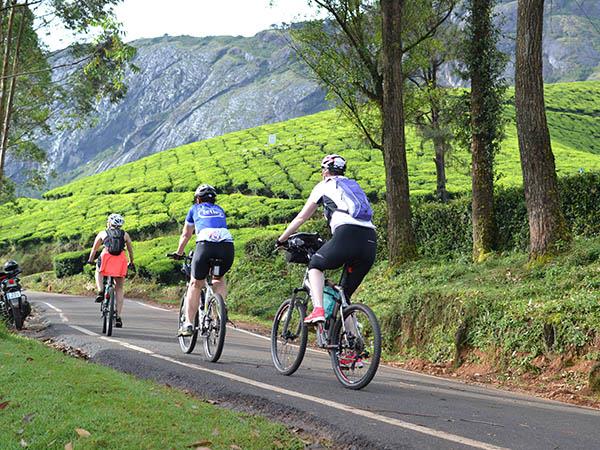
Western Ghats mountain biking holidays, Southern India
Western Ghats mountain biking, off-the-beaten-track
From
US $980
7 days
ex flights


Contact Us

Call us for a chat about our holidays. We are happy to discuss your holiday and help in any way we can. No bots, queues or awful hold music.

01273 823 700
Call us after 9am
Calling from outside the UK


Practicalities
What kind of cycling is this?
This is a moderate cycle – a typical trip might include nine days of cycling, with average daily distances of between 40 and 100km a day. You’ll be best hiring a bike that’s suitable for off- and on-road cycling. You’ll likely cycle in a small group, with a support vehicle on hand to prepare roadside picnic stops; or pick you up if there are any punctures. During time off the bike, you will be able to dive into the culture of the cities – and of course the landscape and beaches.
Where will I stay?
Kerala’s houseboat experiences are famous in the state, where you can sleep afloat on the peaceful backwaters. But there are other interesting places to stay in Kerala and Tamil Nadu – not least home stays, which are a lovely way to support local businesses in cities like Pondicherry and small farming communities like Athoor. There are also hotels, of course.
How hot will it be?
Some of our travellers recommend wearing gloves when you're cycling, as they give more grip than sweaty hands – and sweat is a fact of life here. Whilst being on a bike means that you can generate a cooling breeze whilst you cycle, and cycling near the coast can help, parts of Tamil Nadu’s inland plain can get quite hot and sticky. Climate change is affecting India, as it is the rest of the world.
Relief – and relief lines – are found once you climb up from the Tamil Nadu plateau and into the Western Ghats. This is where people have gone for centuries to seek cooler climes… and there will be a cooler climb to get up into the hills on your bike. The temperatures are perfect for growing – and then subsequently drinking – a warm cup of tea; this you can do among the area’s many tea plantations.
Relief – and relief lines – are found once you climb up from the Tamil Nadu plateau and into the Western Ghats. This is where people have gone for centuries to seek cooler climes… and there will be a cooler climb to get up into the hills on your bike. The temperatures are perfect for growing – and then subsequently drinking – a warm cup of tea; this you can do among the area’s many tea plantations.
How safe are the roads?
One of the best and worst things about cycling in southern India might be sharing the roads: with mopeds, tuk tuks, cows, or trucks laden with produce from the countryside. Whilst you'll be riding along backcountry roads, there may be other road users to consider. The good news is that most of the routes will be quiet; your guide will ensure you are cycling on the safest path – even as you come into larger towns on the route, like Madurai.
The road surfaces are good, which certainly helps. “South Indian states are economically far better than North Indian states,” says Sabir, “And you will see the differences in the road infrastructure.” There are few areas of broken tarmac or unpaved sections on main roads.
The road surfaces are good, which certainly helps. “South Indian states are economically far better than North Indian states,” says Sabir, “And you will see the differences in the road infrastructure.” There are few areas of broken tarmac or unpaved sections on main roads.
How is this trip responsible?
Tamil Nadu and Kerala are among India’s richest states, with higher levels of education and social mobility among the population compared to many areas of northern India. This isn’t to say that you won’t encounter poverty. A responsible tour will make sure that your money is going to places where it will do good, such as local charity initiatives, cottage industries, and local wildlife. Your tour might visit a bird sanctuary, where space for native species is being protected from encroaching agriculture, or a charity that provides veterinary care for street animals. Cycling means that there are plenty of opportunities to stop. There are fewer barriers between you and the communities you pass than there would be if you were staring from the window of a tour bus.
When to go cycling in southern India
November to March is the best part of the year to cycle in Tamil Nadu and Kerala. After March, the temperature creeps up to the high thirties in Chennai, and the monsoon over the summer, peaking in July-August means higher rainfall and no swimming at the beaches. December to January are the driest months.
More India cycling articles
This India cycling guide is not really for Lycra loving roadsters. Relaxed pedallers, read on.
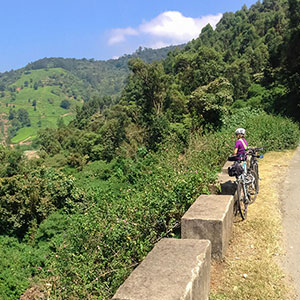
The best time to go on a cycling holiday in India depends on the region you are visiting.
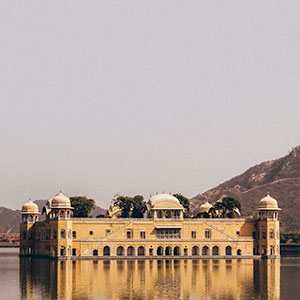
Cycling holidays in Rajasthan are as much about the desert culture as the desert.
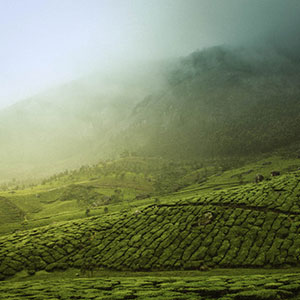
Cycling holidays in Kerala take you from the heights of the Western Ghats down to backwaters and beaches.
From padding to chafing, routes to cultural rules, read our tips and advice for India.