Not all adventures are high octane. Taking the train in Bulgaria is a fun mission, but everything unfolds at the pace of a 1960s train on a narrow-gauge railway: very slowly.
A man in your train compartment has an accordion on his lap – what do you do?
If you want to listen to a song – think twice about nodding encouragement. Shaking your head from side to side means ‘yes’ here, and nodding can mean a firm ‘no’.
Bulgaria’s rolling stock doesn’t always come with wandering musicians – but then again, it is a distinct possibility. By travelling on Bulgaria’s slow and ponderous trains, you’re bound to meet local people.
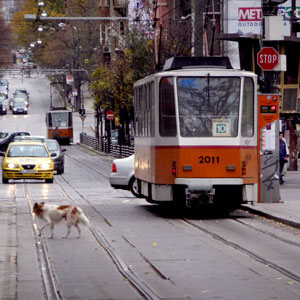
Bulgaria’s trains have a rough-and-readiness about them, and a Balkan charm. People pick their way over the train tracks on foot, and carriages move so slowly you can have a long wave at a train driver in their cab as they make their slow progress out of stations. The trains predate the arrival of capitalism (1990) and the modern tourism industry in Bulgaria. Often the only nod to modernity will be the inevitable graffiti tag on the outside of the carriage. Inside it’s retro and rustic – and that’s why we recommend it.
“Train journeys vary, but most are between three and five hours and people need to change trains,” says Anna Tuliyska from our local Bulgarian partner Odysseia-In. “This can be a little bit of a challenge for customers, but also an adventure. At least, I see it this way.” Travellers agree: this self guided
Bulgaria holiday by train is their most popular Bulgaria tour.
Anna believes their company, founded in 1990, was the first to offer a rail trip in the country to international travellers. Trips are self guided – leaving travellers with the fun of decoding Cyrillic at stations, and chatting to Bulgarian-speaking fellow travellers with translation apps. They also come with the support of a tour dossier and an on-the-ground team.
“Bulgarians today use trains to go from one place to another because there are some small villages where the only connection with other bigger towns is by rail,” says Anna. “Bulgarians use the trains to go to work, to go study, and so on. This is a true and authentic way to meet local people.”