London to Singapore by train
What a long-distance railway journey between London and Singapore tells us about the world.
Yes, you can travel between London and Singapore, and complete over 90 percent of the route by train. Doing so includes the highest railway line in the world, the Sky Train through Tibet, and the 19,500km journey takes 60 days. It also walks a geopolitical tightrope. This voyage gained attention in England in the 1950s after a group of students made the trip by Land Rover. Today’s iteration takes a completely different route – testament to the shifting world. Yet the journey still has the capacity to capture the imagination of anyone who has ever fancied themselves an adventurer.
Yes, you can travel between London and Singapore, and complete over 90 percent of the route by train. Doing so includes the highest railway line in the world, the Sky Train through Tibet, and the 19,500km journey takes 60 days. It also walks a geopolitical tightrope. This voyage gained attention in England in the 1950s after a group of students made the trip by Land Rover. Today’s iteration takes a completely different route – testament to the shifting world. Yet the journey still has the capacity to capture the imagination of anyone who has ever fancied themselves an adventurer.

A changing world
If there’s anything that makes you hyper-aware of geopolitics, its travelling through it.You see it boarding a freighter ship to cross the Caspian Sea, and finding the sea swamped, where hundreds of freighters are now taking materials into Russia. You see it riding the fast new trains that cross from Laos into China, part of the Belt and Road Initiative, in which China has poured billions into developing overland travel across Asia, and China’s new mega-fast line from Lanzhou to Urumqi. You see it in the lines that now run into Europe across Turkey, including a massive new freight line that links Baku in Azerbaijan to Kars in Turkey via Tbilisi.
And you see it in the routes you cannot take. To cross overland from Europe into Asia, you used to pass through Russia or take the so-called ‘Hippie Trail’, which passed through Iran and Afghanistan.

In this post-Covid, war-wracked world, you can still thread a needle and sew countries together by rail.![]()

A geopolitical tightrope
The world is shrinking – and the gaps are narrowing, too. Cross overland from Europe into Asia in the 2020s, and you pass through the needle’s eye: from Turkey and Georgia into Azerbaijan, at its narrowest point, a window of a couple of hundred kilometres across, crossing the Caspian Sea to reach Kazakhstan and avoid travel through Russia.
“I think people look at this and think, wow, this is still possible… in this post-Covid, war-wracked world you can still thread a needle and sew countries together by rail.”
Simon Maddison is executive chairman at our partner Sundowners Overland, who have been running overland tours since 1964. They put on the London to Singapore rail journey in 2014 to celebrate their 50th anniversary and are running it again 10 years later to celebrate 60 years.
Overland travel has always been a delicate act – of poring over maps and piecing together border crossings like jigsaw puzzles. It takes a long time to plan. “It’s a bit of an art,” says Simon. “You create something and you hope people will like it.”
Unlike the original route, this latest version no longer passes through Myanmar. The FCO advises against travel to most parts of the country.
“I think people look at this and think, wow, this is still possible… in this post-Covid, war-wracked world you can still thread a needle and sew countries together by rail.”
Simon Maddison is executive chairman at our partner Sundowners Overland, who have been running overland tours since 1964. They put on the London to Singapore rail journey in 2014 to celebrate their 50th anniversary and are running it again 10 years later to celebrate 60 years.
Overland travel has always been a delicate act – of poring over maps and piecing together border crossings like jigsaw puzzles. It takes a long time to plan. “It’s a bit of an art,” says Simon. “You create something and you hope people will like it.”
Unlike the original route, this latest version no longer passes through Myanmar. The FCO advises against travel to most parts of the country.
A particular kind of passenger
Overlanding is a very particular type of travel, and it’s not for everyone. There won’t be days of sightseeing. Most cities are passed through in a day – or less.You’ll spend extra time in a few places, not because they are more interesting than others, but for more practical reasons – in Lhasa, to acclimatise to your new altitude, in Aktau, Kazakhstan, as a buffer for catching a freight ship over the Caspian. You’ll travel through places you’d never usually think to travel to, and places you may never visit again.
And then there are the early morning arrivals, the late-night departures, the 15 different border controls. “This is an overland journey; it’s not a holiday,” says Simon. “We caution people not to go into this lightly – a journey which will stretch people’s physical capabilities. It is about the journey, and what it means to complete it.”
But for the right person, it’s everything. “This journey really does speak to a certain type of traveller,” says Simon. The trip has garnered huge interest – including from travellers who undertook the 2014 expedition and are back for more.
London-Singapore is a classic city combination that gets attention – you pop Tibet in there and say 95 percent by rail…![]()
A vanishing art
“I think it’s also touched on the fact that you can do this now – but how long can you do this for?” says Simon. “It’s not a fear of missing out, exactly, but particularly post-Covid it’s, ‘What will happen next?’ We can’t take travel for granted. We can’t take these overland experiences for granted.”
Some, including Simon himself, think the golden age of overlanding is no more. It peaked in the 1960s, when hippies crossed through Iran and Pakistan to reach India, and travellers drove across parts of Africa that can no longer be visited safely.
This London-Singapore route comes at a time when rail tours are being dropped by some travel operators as too finnicky to operate, and independent travellers, encouraged to travel by rail, find themselves baulking at the reality – that it takes ages to book, cannot be booked far in advance, and can be expensive and time-consuming.
Simply put, in an era when we are trying to fall in love with train travel gain, but finding plenty of barriers to do so, here’s a ray of hope – as straight as a railway.
Some, including Simon himself, think the golden age of overlanding is no more. It peaked in the 1960s, when hippies crossed through Iran and Pakistan to reach India, and travellers drove across parts of Africa that can no longer be visited safely.
This London-Singapore route comes at a time when rail tours are being dropped by some travel operators as too finnicky to operate, and independent travellers, encouraged to travel by rail, find themselves baulking at the reality – that it takes ages to book, cannot be booked far in advance, and can be expensive and time-consuming.
Simply put, in an era when we are trying to fall in love with train travel gain, but finding plenty of barriers to do so, here’s a ray of hope – as straight as a railway.
Singapore to London by train holiday
Malay Peninsular to Central London in 61 days
From
£22500
61 days
ex flights


Contact Us

Call us for a chat about our holidays. We are happy to discuss your holiday and help in any way we can. No bots, queues or awful hold music.

01273 823 700
Call us after 10am
Calling from outside the UK


About the journey
This is a journey full of stats: cost; length; countries; continents. Travellers journey for 60 days and 19,500km overland between London and Singapore, and over 95 percent of the distance travelled is by train, including a train line through Tibet that reaches an altitude of 5,702m (perhaps slightly more if you’re standing up to visit the buffet car). It passes through 16 countries.
The journey can be done from London to Singapore, or from Singapore to London.
The journey can be done from London to Singapore, or from Singapore to London.
London to Singapore
The journey starts with a whistlestop tour of European capitals; London, Paris, Budapest, Bucharest before crossing to Istanbul – and Asia – on day 7.
Road & sea
The journey’s only section by road is a 300km route between Kars, Turkey and Batumi, Georgia. Trains take you for a dip in Armenia before continuing through Georgia and Azerbaijan to the Caspian Sea, where a cargo ship takes you to Kazakhstan. There’s a long run through Kazakhstan before you cross the mountains into China.
Taking to the Sky Train
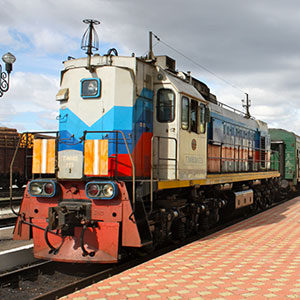
Here, it’s time for the literal highlight of the route, the Sky Train that passes into Tibet. This is a feat of engineering bordering on the miraculous: a train that’s so high up that there’s oxygen available in the carriages, and the train must travel slowly over a series of enormous land bridges because of the unstable layer of permafrost that lies below the tracks.
The final stretch
Heading from Tibet to Southeast Asia involves doubling back into China and heading to Chengdu, where you swivel on a dime and point south. It’s south for several days down the Malay Peninsula via Luang Prabang, Vientiane, Bangkok and Penang and finally – finally – Singapore.
Singapore to London
If you start in Singapore, you start at the city’s famous Raffles Hotel. What better way to whet the appetite for the countries ahead than a hotel named after a British diplomat, opened by the Armenian Sarkies Brothers – countries you’ll arrive at in approximately 15 and 60 days’ time respectively.
Geography lessons
And if this trip gives you a sense of geopolitics, it also gives you a magnificent sense of geography. You may start in Europe with brief sightseeing days at massive monuments to human endeavour: the Louvre at Paris and the Hagia Sophia at Istanbul. But physical geography soon takes over.
The route of the Bosphorus Express through Romania and Bulgaria climbs the heavily forested slopes of the Shipka Pass in the Balkan Mountains, and the geography expands as you move from the smaller-scale scenery of Europe to the larger of central Asia, culminating in Kazakhstan. “You get on the train one day, look out the window – endless steppe,” says Simon. “You go to bed, wake up – endless steppe. You go to bed and wake up the next day – endless steppe. And you think: people used to do this on camels.”
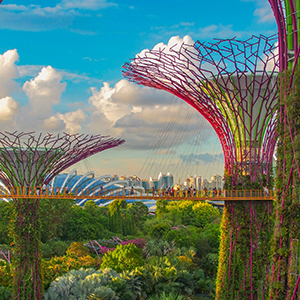
Then: mountains. The Dzungarian Gate into China from Kazakhstan is the only break in a 4,800 km mountain wall that stretches between the two countries. From here, it’s a strange whiplash as you move from the high and dry Tibetan plateau, an area seemingly swept empty by the wind, to a lush tropical rainforest latitude (Singapore is just 100km north of the equator).
The route of the Bosphorus Express through Romania and Bulgaria climbs the heavily forested slopes of the Shipka Pass in the Balkan Mountains, and the geography expands as you move from the smaller-scale scenery of Europe to the larger of central Asia, culminating in Kazakhstan. “You get on the train one day, look out the window – endless steppe,” says Simon. “You go to bed, wake up – endless steppe. You go to bed and wake up the next day – endless steppe. And you think: people used to do this on camels.”
Then: mountains. The Dzungarian Gate into China from Kazakhstan is the only break in a 4,800 km mountain wall that stretches between the two countries. From here, it’s a strange whiplash as you move from the high and dry Tibetan plateau, an area seemingly swept empty by the wind, to a lush tropical rainforest latitude (Singapore is just 100km north of the equator).
The end of the line
Arriving at the end of the trip, staying in one place for more than a couple of days takes some getting used to. The perpetual motion of movement winds down, the juggernaut shudders, and stops. The inertia propels you forward into the next trip – or perhaps a sprawl on a sofa – having balanced on a tightrope for so very long.
More Railway journeys articles
Travel around the whole of India by train, with help from a couple of internal flights, or enjoy the southern states.
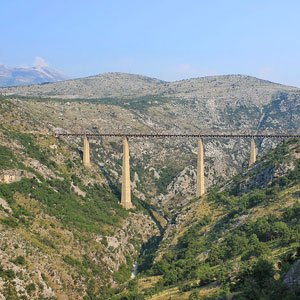
Follow a winding route from Slovenia to Kosovo via a string of utterly underrated cities and mountainous lines.
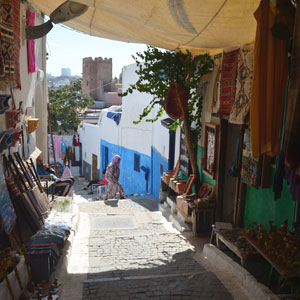
Many of Morocco’s great cities and sights are easy to access by rail, so don’t restrict your adventure to just one place.
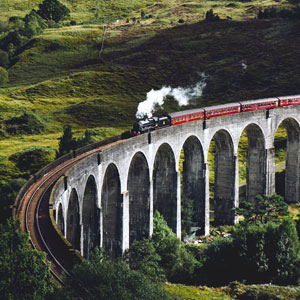
By far the most relaxing way to explore the exquisite extremities of this wild country. Here’s how to explore car-free.
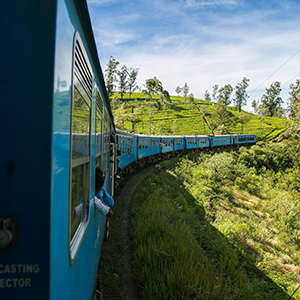
Our top tips and favourite journeys: tea hill trains, coastal sweeps and lesser-trod routes to the north.
Discover our epic rail journeys: all starting in London; all flight free.
Two routes that cross massive distances and reach remote areas.