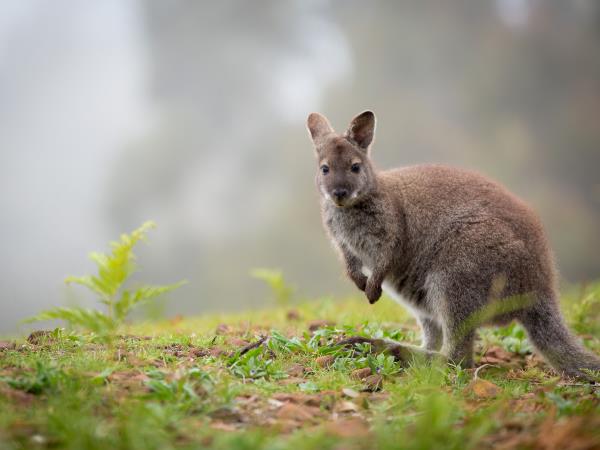
Another island haven of habitats is Maria Island, further up the east coast. Protected by national park status, and completely car free, this is a place to frolic in all things feral. They have every bird going here, from sea birds such as little penguins to pelicans, land birds endemics such as the Tasmanian thornbill and Tasmanian scrubwren, with lagoons a veritable love in for just about every wader going. You can take on a four-day walk on Maria, with guides that will help you sift your way through its glossary of natural gorgeousness from forester kangaroos, possums, wombats, echidna to Tasmanian devils. Although make sure you do some night time walks too, because this is when so many of them come out to play.
The ultimate home for Tasmanian devils is, however, the Tarkine Rainforest, because is the last disease-free population of the Tasmanian devil in Tasmania. Sadly it is at risk of extinction due to a disease known as Devil Facial Tumour Disease, which has wiped out nearly 80 percent of the population in a decade. The Tarkine is their natural habitat and breeding ground, and conservationists are carefully monitoring them here, and everywhere. Once exploited for logging, and still vulnerable without full national park status, the Tarkine still takes off into its own stratosphere of species.
Apart from the devil, there are 60 species of plants or animals that are considered rare or endangered here. Such as the Tasmanian wedge-tailed eagle, the white goshawk and the spotted-tailed quoll. A three- or four-day hike into the rainforest, with expert naturalist guides and staying in wilderness campsites, is really the way to experience its wildlife from dawn until dusk, when the soundscape alone will transport you to a time when this island was part of one big supercontinent known as Gondwanaland. Now, just an island, it certainly still merits super status when it comes to wildlife.










.jpg)
_South_Bruny_2.jpg)
.jpg)