Responsible tourism on tiger safaris

There are only around 5,500 tigers left in the wild, worldwide. There are several issues relating to tiger safaris and to the endangered nature of the species generally. One is the high value put on tigers’ body parts. Their pelts used to be the big seller, but now it is their parts, mostly used in traditional Chinese medicine. The other is the protection of the tiger’s habitats, which must be left pristine not only for the tigers, but for the prey on which they depend for survival. At such a delicate moment in the future of tiger survival, the tourism industry can be a huge lever for change in addressing some of these issues.

Where there's a willy, there's a way

Traditional Chinese Medicine (TCM) goes back to ancient times and included, indeed STILL includes, the use of tigers’ eyes to treat epilepsy, bones to treat rheumatism and the tiger’s brain, for those who don’t have one themselves, for treating acne. However, these remedies were concocted pre-science, and there is still no scientific proof that they work. Famously, the tiger’s penis is also used as an aphrodisiac, served up in soups and sex shops. In addition, all of these conditions, including impotence, have established remedies in Chinese acupuncture and herbal medicine which do not involve the eradication of one of our most precious species. But still the market demand exists and, distressingly, thrives.

It is curious that, even though the World Federation of Chinese Medicine Societies (WFCMS) asked its members, in 2010, not to use tiger bone or any other parts from endangered wildlife, the demand goes on. Some believe it is the high price that continues to push demand, quite simply because they are now precious and ‘prestigious’ resources that only the rich and privileged can acquire. Which, in a booming economy, means tigers are bust. In Taiwan, a bowl of tiger penis soup can cost up to $300, and a pair of eyes $170. Powdered tiger bone costs up to $1,450 for 0.5 kg in Seoul, with demand growing hugely in South Korea. See Tigers in crisis for more details.

Some say that there is nothing we can do to change this demand for tiger parts in TCM. However, with Chinese tourists becoming much more widely travelled now, there are many more opportunities to engage and educate through travel. If you are travelling with a Chinese tourist on a tiger safari, for example, don’t be afraid to raise the subject. The controversy is well known in China and, of course, not everyone in China agrees with this trade. Indeed, Chinese celebrities have gone very public with their message to stop buying these products. Such as Jackie Chan and NBA basketball star Yao Ming who have campaigned on behalf of WildAid with the headline “when the buying stops, the killing does too”. And it is hard to imagine that any Chinese tourist on a tiger safari would ever want to see these beautiful creatures cut up for parts. But with engagement and debate, we can all encourage them to spread the word.
What you can do
Support lobbying charities such as WWF, Born Free and WildAid. It is vital, however, that we also support the responsible tiger safari industry, so that people do not have to poach and kill in order to make a living. Travel Operators for Tigers (TOFT) leads campaigns for responsible tiger tourism in India, and has developed a rating system that measures the ‘footprint’ of individual lodges and hotels in India’s wilderness regions. They also list reputable tiger charities which tourists can support.
Paul Goldstein , top tiger safari guide and expert at one of our leading suppliers, Exodus: “This is an animal we are likely to lose in our lifetime and the blame has a face, and that face is China. Traditional medicine has so much to blame for the loss of tigers in the wild, but actually the poachers aren’t being punished on the ground either. We can’t take on the Chinese traditions and behaviour, where the demand for highly priced tiger parts is highest. But we can stop the poaching. And tourism is one way to do that. Shooting them is another but does not happen in Asia. I saw my first tiger in 1999 in Ranthambore, but it may as well have been this morning as I can remember every moment. Sadly, that tiger’s pelt is now on the back of someone in China, its bones crushed and its penis made into soup.”

Tigers in Crisis: “Consuming tiger parts for medicinal purposes is not limited to Asia. A recent World Wildlife Fund investigation in England of Chinese chemists, craft shops and supermarkets in London, Birmingham, Manchester and Liverpool showed that half the shops sold products claiming to contain tiger bone.”

Adopting a ‘safari mindset’ helps wild tigers

Knowledgeable and skilful guides ensure that you have a good chance of seeing tigers on a safari in India. But sightings are never guaranteed, and sometimes the pressure to deliver on this front to expectant tourists encourages guides and drivers to behave irresponsibly. “Shifting your mindset from ‘tiger safari’ to a safari in its true meaning and showing your guide that you’re interested in everything that goes on in the forest, not just tigers, encourages good practices,” advises Sophie Hartman of our partner Holidays in Rural India. National parks like Pench and Ranthambore are full of amazing animals, birds and insects, as well as trees, flowers and fungi, and guides often have an enormous amount of knowledge to share.

“We also recommend tours that are more than just back-to-back safaris,” says Sophie. “Local communities (especially women) don’t always see much of the money that pours into national parks. So, look for tours that support local enterprises like Pakshoo Pakshee that employ women to make wildlife souvenirs and gives craft making workshops near parks like Kanha and Panna.”

If you want a guaranteed tiger sighting, it could be tempting to visit a zoo, but we recommend you don’t. The infamous Tiger Temple of Kanchanaburi, Thailand, is thankfully long gone, but there’s still a zoo nearby where guests feed, cuddle and walk with big cats, and many other species. These animals may be drugged, and they are kept under very close control, to make them safe around tourists. It’s inhumane and cruelly limits their natural behaviours. You may not always see a tiger on a safari in Asia, but when you do, the experience is far better than seeing one chained up behind a set of bars. Wild animals belong in the wild.

Elephant trekking on tiger safaris

Elephants are still used in a few of India’s national parks as a way to see tigers on safari. As you can see from our Elephant Trekking guide, riding elephants for tourism purposes is not something we support at Responsible Travel.
There are several problems associated with using elephants for tiger safaris, also known as ‘tiger shows’ Firstly, these are quick, ‘drive through’ style safaris, where you are ushered into the forest quickly to see a tiger, and then quickly ushered out again so that the next tourist can jump on. Second, you are generally not guided by a nature expert, but by a mahout or elephant trainer whose only job is to communicate with the elephant, sometimes harshly, rather than with the tourist.
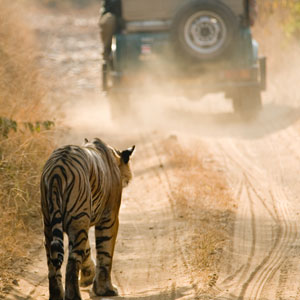
Thirdly, elephants being used for this purpose are sometimes mistreated, shackled and trained with implements such as bullhooks. They may also be stressed by being forced to get close to tigers, something they would not normally do out of choice. And, fourthly, tigers are much more disturbed by fellow creatures of the jungle in their natural habitats, than by jeeps, which have to stop on nearby roads, and don’t trample over their dens and hideaways. Thankfully, however, jeep safaris, are much more prevalent these days, and in Nepal, there are many more safaris on foot as well. With no one using a bullhook to get you to move.
Julian Matthews , founder and chair of tourism action charity Travel Operators for Tigers (TOFTigers) which aims to use tourism to support tiger conservation more effectively:

“In India, if you go on an elephant to see tigers you are generally with a mahout, or an elephant driver. Usually, he can’t speak English and is unlikely to be an expert naturalist. Which makes the whole thing much more of a passive nature experience in India, as you can’t ask questions about the wildlife. You often have a few minutes on the elephant’s back, take two or three pictures, and then come back again. You might have 60 tourists getting on the back of a fleet of elephants every few minutes - a pretty uninspiring way to view tigers really.“

Responsible tourism tips

Find a responsible tour operator. Responsible Travel has spent considerable time screening all the tour providers listed on our site, and has transparent responsible travel policies. We also publish unedited, warts-and-all reviews of our guests experiences which frequently include conservation issues. Because of the demand for tiger watching there are more mini buses, called canters, going through some of the big national parks now, such as Ranthambhore. This isn’t ideal for the environment or habitats but it is good for generating conservation income, which is the ever present fine line in responsible tourism debates. The policy on minibuses varies per state in India. If you go to some of the smaller parks such as Tadoba or Bandhavgarh National Parks, jeep numbers are limited and no minibuses are allowed. You will also have a more pleasant tiger watching experience from a jeep than from the back of a bus. Interpretation on Indian tiger safaris is still limited, especially compared with wildlife safaris in Africa. The national park rangers are seen more as crowd controllers in some places, giving people instructions on where to go and what to do rather than sharing environmental and conservation knowledge. This is something that needs to change at educational institution level.
The maximum speed limit within national parks, particularly in India, is 20km per hour. Your driver should never exceed this. Always keep noise to a minimum when on a tiger safari. Disturbed wildlife such as tiger, bear and India bison may attack your vehicle if unduly startled. This also means turning off your mobile phone. One of the best things you can do is report any bad practice on the part of operators. You don’t have to have a degree in nature conservation to realise that a guide or driver is not acting appropriately. There are so many ways of spreading good and bad word, using TripAdvisor and social media, or reporting an incident through Travel Operators for Tigers (TOFT). If you can, take photos or videos as proof of unethical guiding.
Belinda Wright, OBE, Executive Director, Wildlife Protection Society of India (WPSI):

“Responsible tourism is a critical issue that needs to be practised and supported by visitors. Follow the Code of Conduct of the park authorities and the resorts (most of the best wildlife resorts have one), support local arts and crafts and local community efforts, and be sure to ask your hosts about their eco-friendly, sustainable tourism practices. Tour Operators for Tigers (TOFT) is India's voice for responsible tourism in tiger wilderness areas. They carry out audits and award PUG certificates using an eco-rating system.”
Written by Catherine Mack
Photo credits: [Page banner: Annie Spratt] [Tiger by water: Hans Veth] [Chinese pharmacy: Michael O'Connell-Davidson] [Elephant trekking: Matteo] [Tiger mania: Sankara Subramanian]